
Now you might be wondering, “why these three?” I mean, it makes sense to compare the X-570 and X-700 because they’re more or less siblings in the X-series. But why throw the XG-M in the mix and not the more obvious third choice of the X-370? After all, the XG-series is Minolta’s budget series.
Well, be that as it may, the XG-M represents the pinnacle of the XG series and is the highest spec’d model of that group. And in my view, it has features that put it in the same ballpark as the X-700 and X-570 – at a MUCH better price point. So I do think it’s worth taking a look at. Basically I’m suggesting that the top of the line XG camera is a better value than the bottom of the line X-series camera. Plus, I don’t own an X-370…so there’s that. But anyway, let’s take a look at the backstory.
The Minolta XG series debuted back in 1977 as the budget line of cameras opposite the XD series. If you’re familiar with the XD cameras you know they’re pretty darn good (and a subject for another video). But the XGs really existed to fill the entry-level space. They offered Cadmium-sulfide cell metering, and aperture-priority autoexposure with manual exposure capability. However, the biggest downside to the XGs at the time was that if you put the camera in manual mode, the meter doesn’t work. So using one of these in manual mode meant using an external meter, and what entry-level shooter is gonna want to do that? Well, probably no one.
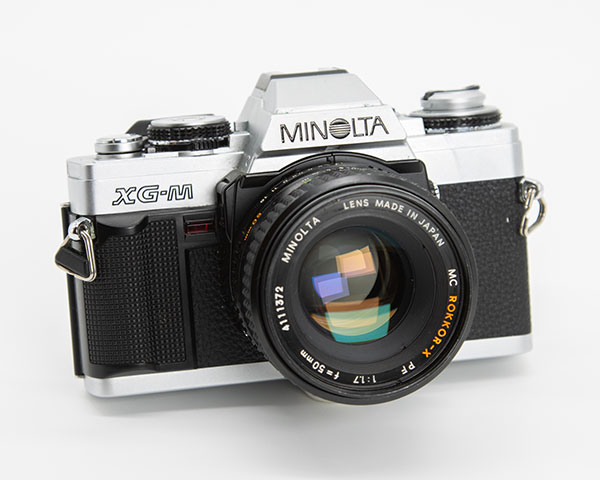
It wouldn’t be until 1981 when they released the XG-M that Minolta would finally fix that and have the meter actually work in manual mode. And that makes the XG-M – to me at least – finally seem like a useful camera. And it has good specs to boot.
In addition to manual mode, it offers aperture priority autoexposure – with speeds ranging from 1 second to 1/1000 second; exposure compensation; depth-of-field preview; and a PC flash connection in addition to the hot-shoe. The main reason this camera is included in the XG budget lineup is because it utilizes Cadmium-sulfide (or CdS) cells for the metering. And in 1981, that was becoming obsolete technology.
But cadmium-sulfide based metering HAD been the benchmark standard on cameras well into the mid-70s. And there are a lot of excellent cameras that utilized it because it was the best method at the time. But when Minolta released the XD-series, they implemented a new metering technology based on Silicon photo cells. These new cells responded faster and had a slightly wider metering range than the CdS cells with an additional stop of sensitivity on the low and high end. The new Silicon cells could also be powered by standard 1.5v batteries instead of the 1.35v mercury batteries that most CdS metering systems used. So, that was definitely an upgrade.
That being said, though. The XG-M doesn’t use the old mercury batteries for its CdS meter. It uses modern 1.5 volts. So, I’m gonna assume that it has some form of voltage regulation incorporated. And that’s a good thing. So chalk one up to the XG-M.
Now, also in 1981, Minolta’s ready to release the first camera of a brand new line – the X-series. This new series would also utilize the new Silicon cells for metering, And that first X-camera was the X-700. And it was going to include the relatively new Programmed exposure mode. And folks were excited about it.
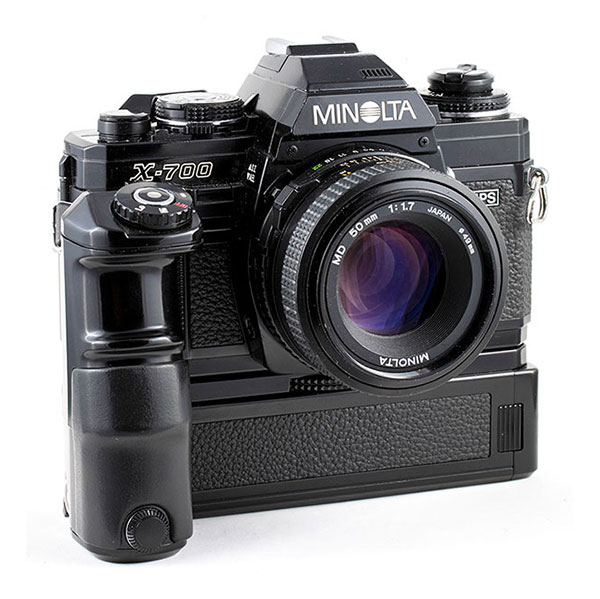
It allowed you to use the camera almost like a point-and-shoot. It would choose the shutter speed AND f/stop for you. And that was a big deal for a lot of photographers. Because it made the X-700 a camera that you could “grow” with. You might start out just using the Program mode, but as you developed your photo skills you could start using the Aperture priority mode, and then even move on to manual mode when you felt comfortable to do so. And I think that’s probably the main reason the X-700 was such a great seller. There are a lot of Gen X’ers out there whose first SLR was an X-700 – me included. I got this one from my dad at Christmas 1985, and I still remember how excited I was. Good times, indeed.
(One important thing to note here about using the Program mode. In order for it to work as intended, you’ll need to be using MD lenses, not the older MC lenses. And this also applies to the aforementioned XD-series cameras.)
Now if you did want to use the X-700 or XG-M in manual mode, the metering worked the same way for both. In the viewfinder, when you pick an f/stop (which IS visible in the viewfinder), an LED is going to illuminate next to the suggested shutter speed. But the downside of this system is that it doesn’t show you what speed the shutter is currently set to.
Now besides the different metering systems and the lack of a Program mode on the XG-M, there are a few additional advantages that the X-700 has. First, is that when in Programmed or Aperture Priority mode, the shutter speed range increases. When manually choosing a shutter speed, 1 second is the longest. But when using the X-700 in either of the auto modes, the range is extended to 4 seconds. In the XG-M, 1 second is the longest speed – period.
Secondly, it has 9 interchangeable focusing screens, where the XG-M’s screen is fixed. The factory-supplied screens on all of these, however, are bright with a split-image rangefinder surrounded by a microprism collar and are suitable for most situations. Update: it’s been brought to my attention that the XG-M is capable of swapping screens – even though the camera manual states otherwise.
And thirdly, the X-700 offers TTL flash control for the first time on a Minolta camera. And I know I don’t talk about flash much on this site, but TTL – or through-the-lens – controlled flash is an absolute game-changer if you have to use a shoe-mount flash on a regular basis.
So, to recap – the differences between the top of the line X-series camera and the top of the line XG-series camera are:
The X-700 has a slightly more sensitive metering system than the XG-M. It offers Programmed exposure mode, an extended shutter speed range in either of the autoexposure modes, has 9 available focusing screens, and has TTL flash capability – even though that probably has no bearing on how we might use the camera today.
Now – the X-570. It wasn’t released until 1983 – two years after the XG-M and X-700. And in that short span of time Minolta was able to make some improvements. The most notable of which was displaying the currently-set shutter speed in the viewfinder. So now in manual mode, you can make adjustments to the shutter speed without the need to take your eye away from the viewfinder.

So that means that with the X-570 in manual mode, you can approach it in two ways. Since you see the actual set shutter speed in the finder – which is indicated by the blinking LED, you can adjust the f/stop until the recommended shutter speed matches the set speed, OR you can pick an f/stop and adjust the shutter speed to match the recommended speed. And again, this differs from the XG-M and X-700 because neither of those cameras show you the currently-set shutter speed in the finder. So, it’s a small change, but definitely a big improvement if you like to use manual metering.
A second upgrade to the X-570 is a two-stop increase in the film speed range – from ISO 12-3200. With the XG-M and X-700 the range is ISO 25-1600.
So, with these improvements, why isn’t the X-570 considered the all-around better camera? Because…market segmentation. Minolta still has to make the X-700 the “best” camera. So, the 570 doesn’t offer the Program exposure mode that the X-700 has – OK, but it also doesn’t have exposure compensation like the X-700 does. So they took it up two notches with the improved manual metering and increased ISO range, but then took it back down two notches by not including exposure compensation or Program mode.
Exposure compensation is probably unnecessary though if you plan on shooting in manual mode – since you can just adjust or compensate for the exposure yourself. But in an automatic mode – like Program or Aperture-priority – it’s really the best way to override the cameras’ metering system. But it’s not the only way.
If you really want to override the camera meter, you can do this by adjusting your ISO/film speed. To add exposure to the camera meter’s recommended setting, just lower the film speed. To subtract exposure – just increase it. Just be aware and remember to turn it back to the correct one when you’re done.
But this same awareness equally applies when using the actual exposure compensation control on the XG-M. It’s easy to forget you’ve changed it. And the camera doesn’t give you any warning in the viewfinder that it’s been adjusted. On the other hand, the X-700 DOES give you a warning for that.
But besides the Program mode and exposure compensation control, the 570 is the same as the 700 – using the improved Silicon metering system and being capable of TTL controlled flash and 9 available focusing screens.
Now, I do think there are certain circumstances where the 570 might just be the better choice.
First – If you mainly shoot in manual mode, the updated viewfinder info is gonna be super helpful. And…if you mainly do shoot in manual mode, you don’t really need the exposure compensation feature. Because if you need to make compensation, you just do that manually.
Secondly, if you only have the MC lenses and not the MDs, the X-570 – as well as the XG-M – are better choices than the X-700. Because to make use of the Program feature on the X-700, you need MD lenses.
When it comes to current prices, the X-700 and X-570 are about the same – currently hovering around the $150-200 range with a lens. And I think the choice really comes down to whether you require program mode (the X-700) or do you want a better manual exposure experience (the 570). If you do value the program mode, just be sure that you have MD-series lenses to use with the X-700. The MC lenses will work, but not in Program mode.
The XG-M however, I think is a terrific value. Because it’s prices are considerably lower than the other two. Most of them well below the $100 USD mark. And a lot of those are also gonna include a lens. And even though it’s considered a budget series, you’re really not giving up much by choosing it over the other two.
You don’t have program mode, the metering range is one stop less sensitive on the low end and one stop less sensitive on the high end of the range, you don’t have TTL flash (which I think is a moot point anyway), and you don’t have interchangeable focusing screens (although the factory-supplied screens on all of these are perfectly fine for most shooting situations). BUT – you can use either MD or MC lenses with it, it has depth of field preview and a PC socket, AND it’s compatible with the Motor Drive 1 – just like the others are.
Check out the video below for the full comparison/review.


