
In my last post, I looked at the beginnings of the Argus cameras and spent most of the time looking at the famous C-3 – otherwise known as the “brick” – and how it helped popularize the 35mm film format for casual photographers. The C-3 was a camera that simply worked well without too many bells and whistles – or maybe NO bells and whistles. It’s design and function was completely practical and utilitarian. A box with a lens, constructed out of inexpensive Bakelite, passing the monetary savings on to the consumer. A camera that matched it’s target audience so well, it remained in production for almost 30 years with only minimal changes ever made.
But that didn’t mean that Argus was resting on its laurels. They still had a lot going on in terms of camera design and development. And that included new camera models in the original A-Series.
In 1947, they released the Argus 21 – also known as the “Markfinder”. It was sort of an evolution of the A3 – retaining the rounded body ends, but with a new top plate and new lens. The Markfinder looks like a rangefinder, but the second window is only for projecting frame lines in the viewfinder. But Argus would use this body as the basis for a brand new C-series camera that was released in 1951, the C-4.
If we were to place the C4 and C3 side by side, I think it would be understandable for one to assume they’re from two different camera companies. Because externally, there’s very little similarity. Where the C-3 is literally brick-shaped and made of Bakelite plastic, the C-4 is made of metal and reflects a more traditional camera design. And where the C-3 rangefinder had it’s own separate window from the viewfinder, the C-4’s rangefinder is superimposed in the main viewfinder. And that’s a big improvement.
Other improvements over the C-3 were a hot-shoe for connecting a flash and a new, faster lens – although unlike the C-3, the lens on the factory C-4 wasn’t interchangeable. But… these cameras proved to be popular – enough so that a third party – Geiss America – actually modified the factory C-4s to accept interchangeable lenses.
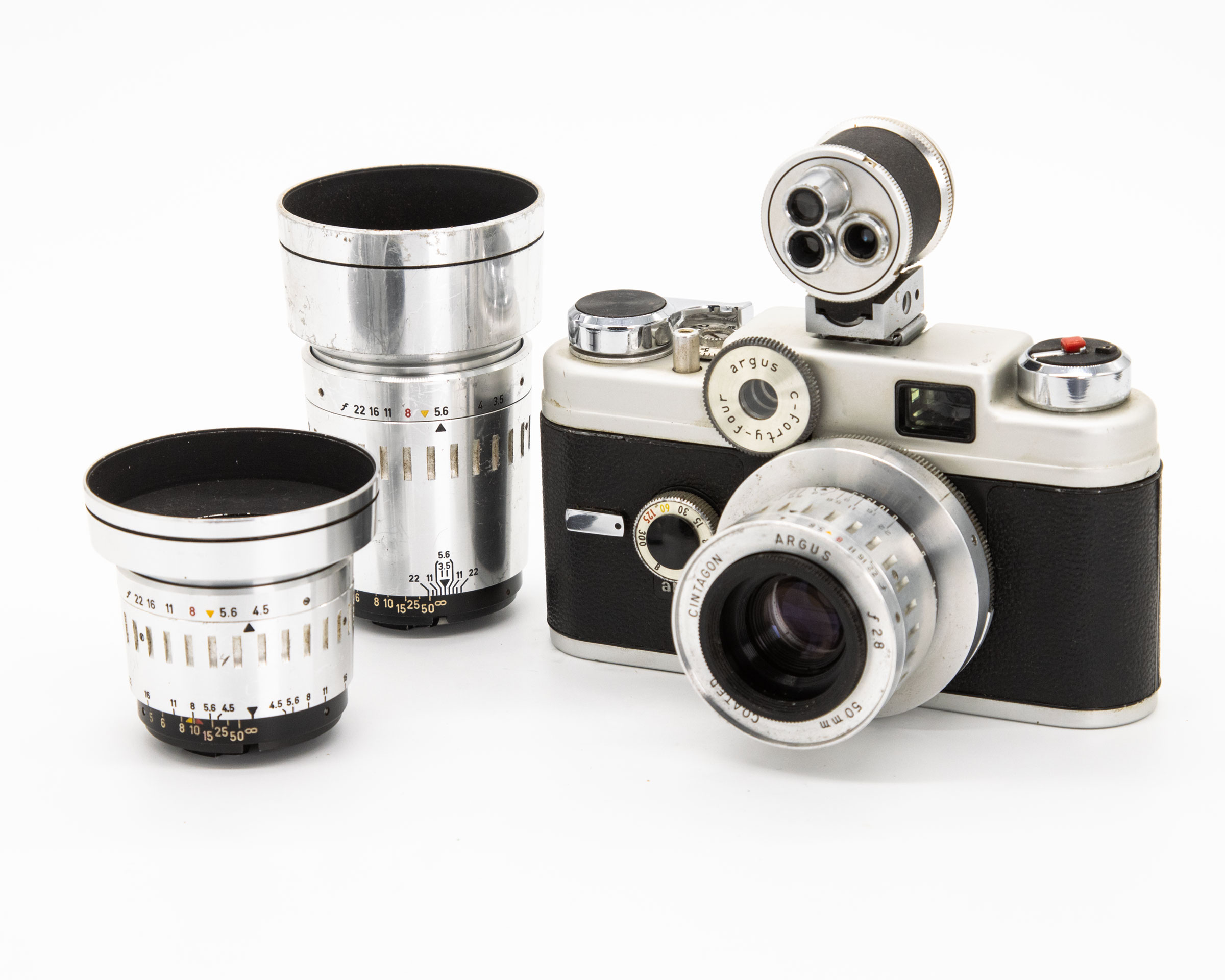
In 1956, however, 5 years after the C-4 hit the shelves, Argus came up with their own interchangeable lens solution in the form of … the C-44. And it was really just a C-4 with a bayonet lens mount.
The standard 50mm 2.8 Cintagon is a four-element Tessar design which was manufactured at the factory in Ann Arbor, Michigan. The additional lenses though – also branded as Cintagon – were built in Germany by Steinhill in Munich. There is a 35mm 4.5, a 100mm 3.5 AND another 50mm – this one with a maximum aperture of f/1.9.
And if you did read the previous Argus article and watch the accompanying video, you’ll recall how much of a pain it was to change out those lenses. Luckily, it’s not such a tough job on the C-44 – although some still find it a bit fiddly.
As for camera controls, the shutter speeds are selected by a dial on the right front, and similar to the C-3, we have a limited choice of speeds. But they include 1/10, 1/25, 1/50, 1/100 and 1/300 of a second, plus B.
Also like the C-3, focusing is intended to be done using the geared wheel surrounding the rangefinder window. In practice though, that gear is hard to operate since the gear on the bayonet mount is so large. So you may do just as well by focusing with the bayonet mount itself.
On the top right shoulder is the shutter release, wind knob and the frame counter (which counts down backwards, by the way).
In the middle is an actual hot-shoe – which I think is unusual on a camera from this era – and just below that on the back is a switch where you can choose the flash sync method of M or X.
And over on the top left shoulder is the rewind knob.
In 1958, Argus gave the camera an update and called it the C-44R. And it sported some improvements. The wind knob was replaced by a plastic rapid wind lever (that takes two strokes to advance the film). And the rewind knob was replaced by a plastic rewind crank.
Another slight change was that the shutter speeds now mostly reflected the standardized speeds of ⅛, 1/15, 1/30, 1/60, 1/125 of a second – although the fastest marked speed is still 1/300 sec.
And right next to the shutter dial is a chrome bar for mounting a coupled proprietary light meter.
One thing that I’ve found inconsistent on the C-44 cameras is that the shutter speed indicating dot on the body can be in different places depending on the year it was made. On the C-44R, the indicator dot is on the chrome bar to the side. On this C-44, the indicator dot is at the top of the dial. But on this parts body that I have – which is a much lower serial number – the indicator dot is at the bottom and part of the Argus logo. So just be aware that if you have a couple of these bodies, setting the shutter speed might be a little different. You may think you have 1/300 second set, but it’s really 1/10. Or vice versa.
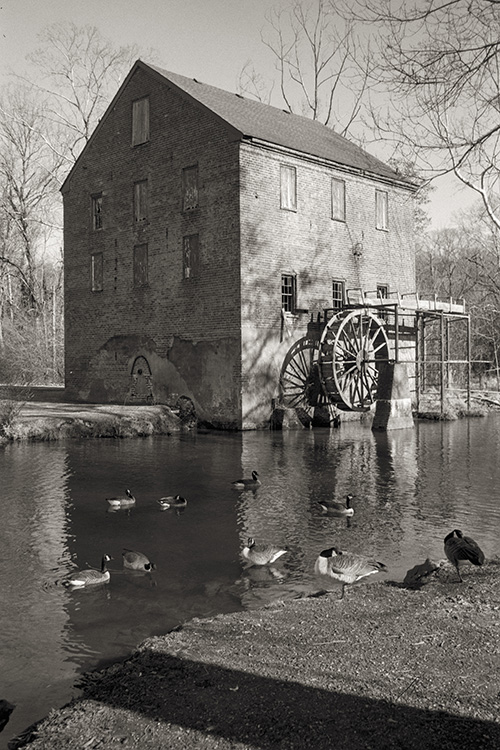
Here’s one of my favorite photos from the roll of Ilford Delta 100 I made with the C-44. Shot with the 35mm Cintagon lens.
Check out the video below for the full review and photo shoot. Spoiler alert: I do like this camera. A lot.


