
Today’s topic is the Lynx-series of rangefinders from Yashica. And I’m probably going to upset many Yashica fans by stating that any camera of this series is a better Yashica than any of the Electro 35 models.
Now I know that the Electro 35s are some of the most popular film-camera rangefinders out there. Maybe it’s because of that spider-man movie 20 years ago? I don’t know. But years ago, when I was first getting back into film photography, that camera seemed to be near the top of everyone’s list. So, I got one. And it’s a fine camera. But I don’t think it’s the best choice out there – especially when you compare it to these.
The main thing that makes the Lynx series cameras worth looking into is that their operation is completely manual. We can choose the f/stop and the shutter speed. The Electro, on the other hand, is aperture-priority autoexposure only (except for the flash setting). Otherwise, there’s no direct way to access the shutter speeds.
Now I am aware of a couple of ways you can sort of trick the Electro into a known speed, but with the Lynx cameras, we don’t have to do that. We have a full set of speeds to choose from.
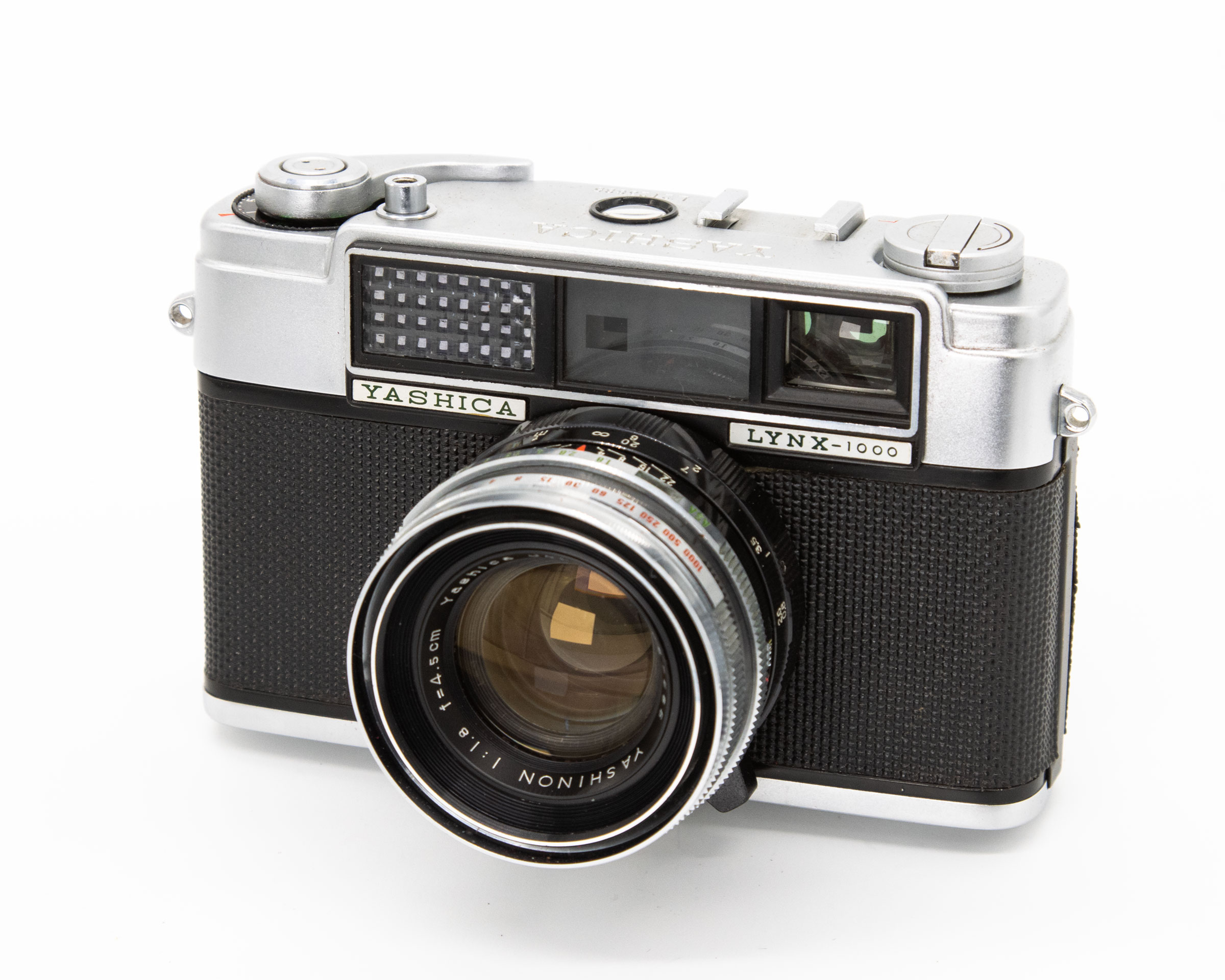
Let’s take a look at the Lynx-1000. It first appeared back in 1960. It’s fully manual and mechanical and uses a selenium cell meter, so even that doesn’t require a battery. Is this one working? Yep. Is it accurate? Sort of. Selenium meters tend to degrade over the years, and the one in this camera is about 65 years old. So I’d probably use an external meter with this one. Still – I’ll always be amazed at the science of a lightmeter that doesn’t require a battery to operate. But I digress.
The camera has a 45mm f/1.8 Yashinon lens constructed of 6 elements in 4 groups with f/stops to f/22. And people really like this lens, because you can find info online about how you’re able to adapt it to modern cameras. Looks like a lot of work, and I’m not sure I’d want to try it, but it is a thing. The camera also sports a Copal-SV leaf shutter that provides…drum roll here…a top speed of 1/1000 of a second. Hence the name Lynx-1000. And that fast of a speed on a camera that uses a leaf-shutter isn’t that common. Not unheard of, but definitely un-common.
The camera also has bright frame lines projected in the viewfinder that automatically compensate for parallax. And at the top of the finder there’s a match-needle system for the meter AS WELL AS one on the top plate of the camera by the accessory shoe. It doesn’t have a hot shoe, but does have a PC connection right here near the bottom. This camera gives me what the Electro 35 does not – complete manual control with a blazing fast top shutter speed. And it does all of that while being smaller than the Electro. This is a lovely little camera with a fantastic lens.
Sometime around 1965, Yashica updated this camera to include a new CdS meter. This camera DOES use a battery, but only for the meter. And they changed it’s name to the Lynx-5000. In addition to the new meter, they did change the overall design, as well. But it’s still a rather small camera.
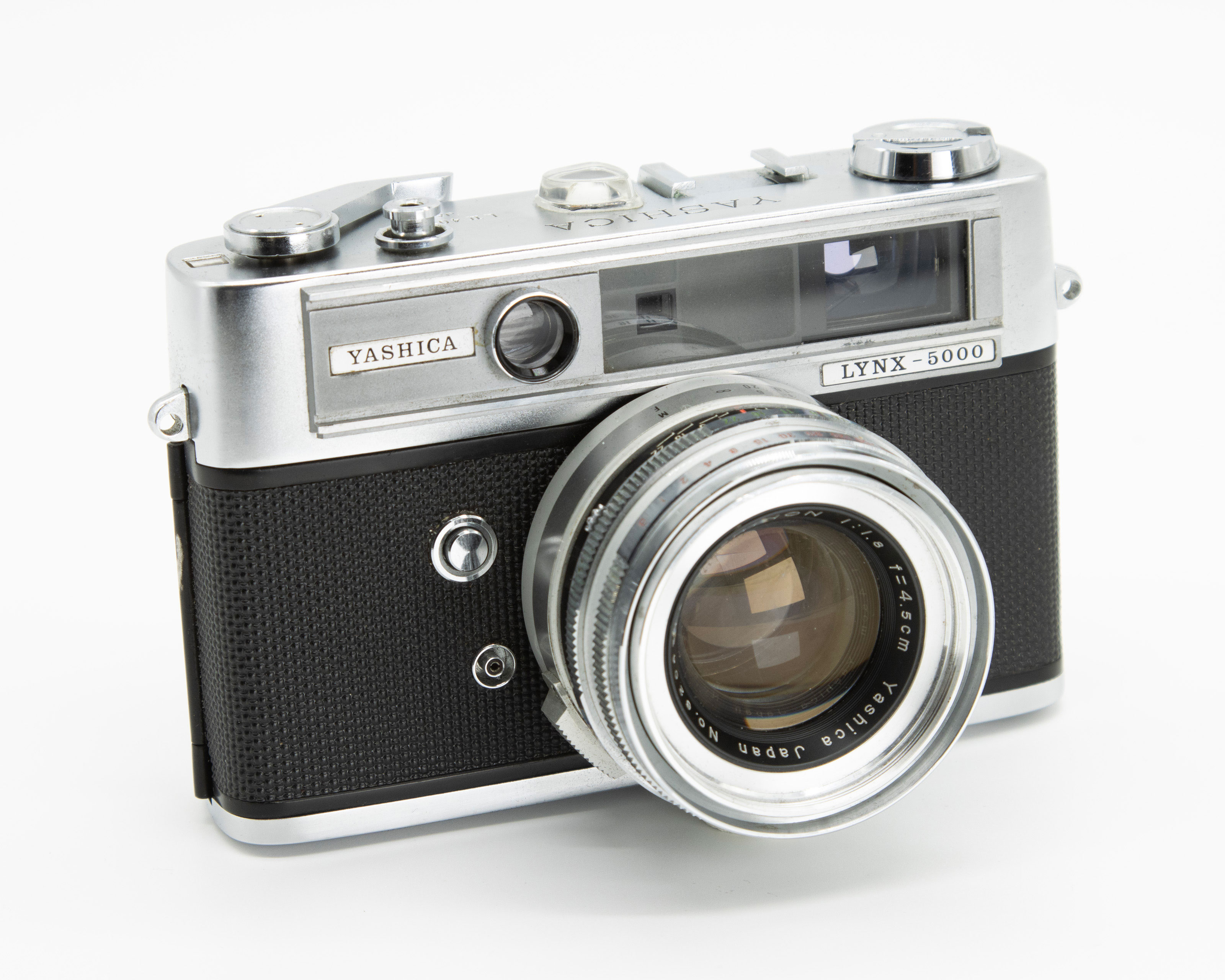
Now since I’ve brought it up, If you’re wondering what the difference is between a Selenium-based meter and a CdS meter, it’s that selenium cells require a relatively high level of light in order to covert it into enough voltage to actuate the galvanometer to move the needle. And that minimum amount is somewhere around EV 4. In low light situations, then, there may not be enough light to register via the needle. So they aren’t very accurate in low light.
An additional issue with selenium meters is that they will deteriorate over time – especially if the meter is constantly exposed to light. But these cameras can often be found with their ever-ready case. And if the camera’s been stored in that over all these years, there’s a good chance the meter will still be functional.
Now the battery-operated CdS cells don’t require as much light to render an accurate reading via the galvanometer. Their minimum sensitivity is down around the EV 1 range. So that is a lot better. Still, I think the physics behind a battery-less light meter is nothing short of amazing. So, I hope you’ll forgive me for this bit of a tangent and the opportunity to use the word “galvanometer” a couple of times. Now back to the cameras…
So we have the Lynx-1000 and 5000, but Yashica had another trick up their sleeve. Because also in 1965, they gave us yet another camera I think is better than the Electro 35 – the Lynx-14. And ya’ll are probably going so, what, does the shutter only go to 1/14 of a second?? Well no. In this case that number doesn’t reflect anything about the shutter at all. It’s about the aperture. Because the Lynx-14 is the only fixed-lens rangefinder ever that offered an f/1.4 lens.
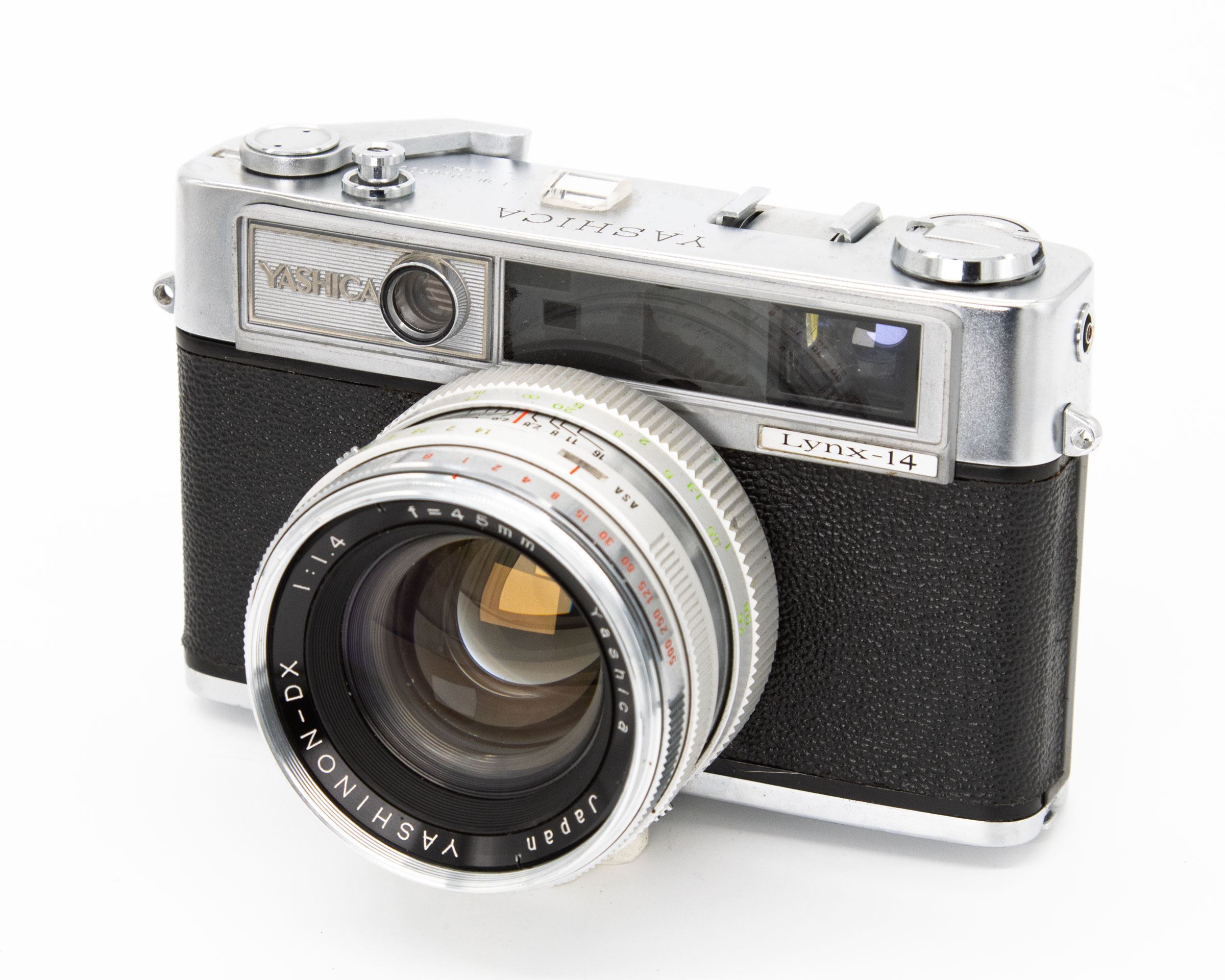
When we’re talking about fixed-lens rangefinders, the fastest lenses are generally f/1.7. But there are a special handful – well actually not even that many – that have lenses faster than 1.7. The Konica Auto S1.6 has an f/1.6 lens, and one version of the Mamiya Super Deluxe has an f/1.5 lens. But that’s it. So as far as 1.4 goes – the Lynx-14 is it.
It operates pretty much like the Lynx-1000 and 5000. Like the 5000, it incorporates a CdS meter circuit powered by battery. Oh, and guess what battery these cameras use? Yep. The good ol mercury type. So you’ll need to pick up one of the 1.35v Wein batteries.
The one major difference between the Lynx-14 and the other Lynxes is the shutter. The 14 has a Copal SVE that provides a top shutter speed of only 1/500 sec. Apparently, the massive lens made 1/1000 sec impossible. And speaking of the lens, it’s a 45mm f/1.4 Yashinon DX. Constructed of 7 elements in 5 groups, and it has the reputation of being one of the sharpest lenses among fixed-lens rangefinders.
Now, if you go looking for either one of the 5000s or a 14, you’re gonna see some listed as 5000E or 14E. Those are further updated models that used an Integrated Circuit for metering. These will be marked with an “IC” below the Yashica badge on the front. These got rid of the match-needle system in favor of LEDs. With these models, the words “over” and “under” appear in the viewfinder to let you know to adjust shutter speed or f/stop. When you see no lights at all, that’s when you know you have a good exposure. And THIS is very similar to the metering info you get on the Electro 35s. I kinda prefer a match-needle system over the LEDs. But the match-needle is hard to see in dim light, so the LEDs are a bit of an improvement.
For the full review and sample photos taken with the Lynx-14, check out the video!


