

The Minolta SRT-101 started the quite popular lineage of SRT-series cameras from Minolta. Following the 101, we also got the 100, the 102, the 200, 201 and 202, a few dedicated models produced for specific department stores, AND one – the SR-M – that had a built-in motor drive. In one form or another, and alongside some of their electronically-controlled bodies like the XE, XG and XD-series, the mechanical SRT series was produced for 15 years – all the way up to 1981. And for good reason: they simply worked. Completely manual, no fancy auto-exposure modes, and a quite accurate metering system. And if the SRTs have a so-called claim to fame, it’s gonna be that metering system. But let’s back up just a bit to get the full picture.
In 1963, Topcon released the RE Super. This camera can be considered as the first camera to offer what we now know as Through-the-Lens – or TTL – metering. Meaning it only measured what the lens was seeing, and wouldn’t be influenced by areas NOT included in the composition.
Now the RE Super was ahead of its time in more ways than one. Not only did it provide TTL metering, but it allowed for metering at full aperture. We take this totally for granted today, but it was a watershed feature for the early 1960s. Because the opposite of full aperture metering is what we call stop-down metering. Meaning that in order to meter the scene properly through the lens, you’d need to stop the lens down to the taking aperture. And if you’ve ever used the depth of field preview button on a camera, you’ll know that stopping down to smaller f/stops such as f/16 or 22 make the viewfinder considerably darker and therefore more difficult to focus accurately. But by and large, the first TTL metering systems from most manufacturers used this stop down method – even into the early 1970s. With the exception of Topcon…and Minolta.
Three years after the Topcon RE Super, Minolta released the SRT-101 that featured full-aperture, TTL metering. And they implemented it differently than Topcon. The Topcon camera had the metering cells located behind the mirror. Which meant that portions of the mirror had to be de-silvered to let the light pass through to the cells. This meant that the image you saw in the viewfinder wouldn’t be 100% complete. But the Minolta SRT-101 placed the metering cells in the prism, which in-turn left the mirror untouched, and the image un-obscured.
And notice I said “cells” as in plural. Cause the 101 had two cells, each reading a different part of the focusing screen, and in effect, giving us a very early implementation of the multi-pattern or matrix metering that would appear on all cameras beginning in the late 1980s. Minolta called this Contrast Light Compensator – or CLC. And it was configured so that contrasty lighting situations such as a backlit subject or subject with bright sky wouldn’t leave the darker areas underexposed. And it pretty much worked. It was a rather cutting-edge system for the time. And I think the camera’s price certainly reflected that. On it’s release, the listed price of the SRT-101 fitted with a 50mm 1.4, plus a case was $319 USD. If we adjust for inflation, that would put it at about $3100 USD in 2025 money. So, think about how much camera 3 grand will get you today, and I think we’ll agree that this wasn’t meant to be an entry-level camera.
So, with all this in mind, let’s take a look at the entire SRT line-up. Since these cameras were produced in such a long run, there were slight changes made here and there, and I’ll try to point those out as we go along. I’m absolutely certain that I’ll miss some of them, but I’ll do the best I can.

Now, let’s start with the first one – the SRT-101. This one pictured is an early model, and we know that because the shutter speed control dial is solid black with a finely grooved edge. Another way we can tell it’s an early one is that it uses slotted screws. At some point early in the production run, Minolta changed from Japanese Industrial Standards, to ISO standards. And that brought about the first series of changes. One of the minor ones was the switch to Phillips head screws. And another sort-of minor change was the design of the shutter speed dial – which replaced the solid black one with a chrome one with a more knobby edge, although the face of it remained unchanged. And besides this, the entire SRT line has pretty similar controls.
The shutter speed range is 1 – 1/1000 sec plus B with an X-Flash sync of 1/60 of a second. You adjust the film speed by pulling up on the edge of the shutter dial and rotating it. The ASA range, by the way, is from 6-6400.
Beside the shutter dial is the wind lever that surrounds the shutter release. And to the right of that is the frame counter. Below that on the front is the self-timer lever, the mirror lock up switch, and the depth of field preview. On the other side of the lens mount are the PC contacts for FP and X-Sync – one for each. And above that is the lens release. On the top left shoulder is the rewind lever and back latch. On the 101’s prism is a cold shoe. All other models featured a hot shoe.
And on the bottom you’ve got the meter/battery check switch, the tripod socket,the battery chamber and film rewind button. By the way, the battery for this was, of course, the old 1.35v mercury battery. You CAN get exact-voltage, modern replacements for these, though. So that’s not a deal-breaker.
If we take a look in the finder, you’ll see the whole range of shutter speeds across the bottom and the match needle metering set on the right. The indicators at the top and bottom show if the subject is within metering range, and the square indicator is the battery check mark. To check the battery, set the switch on the bottom of the camera to BC, and if the needle aligns with this mark, the battery is good.

Metering is pretty simple, adjust shutter speed or aperture until the follower needle aligns with the indicator needle. I absolutely love the simplicity of a match needle system. And while we’re talking about the meter, it has a sensitivity of EV-3 to EV-17. And as far as I can tell, this is the same for all the different models.
Focusing on the 101 is aided by a central micro-prism spot.
One thing to note that probably was a detractor for pros is that none of the standard SRT models would accept an auto winder or motor drive. And to remedy this to a point, the next camera to appear after the 101 was the SR-M. It had an integrated motor drive that was capable of about 3 fps. It had built-in handle with a secondary shutter release. And apparently these are pretty rare.
The next SRT – the SRT-100 was released 5 years later in 1971 and was the budget model for the system. It used the same cool metering system, BUT omitted a lot of the features of the 101. It’s top shutter speed was 1/500 sec, it had no self-timer and no mirror lock up. And the viewfinder was quite sparse – showing only the meter info and that’s it.

But in 1973, Minolta upped its game when they released the new flagship of the SRT line – the 102. It kept all the features of the 101 and added a few additional features. The big one, to me at least, was the addition of a periscope window on the pentaprism that could show the selected aperture in the viewfinder. This required use of the newly designed MC lenses which placed the markings of the aperture ring in a position to be read by the little window. Older lenses would work fine on the camera, but you wouldn’t be able to see the aperture info.
Among the upgrades was the addition of a split image to the micro prism spot on the focusing screen and the inclusion of a hot-shoe on the pentaprism.

Addtionally, the 102 finally offered a consistent method of creating multiple exposures. Simply press the film rewind button and use the winder to cock the shutter. This method has always sorta been the “hack” to create multiple exposures on a lot of cameras. But the 102 was designed so that this would actually work where the frames would actually stay in register.
Also with the release of the 102 we get the first glimpse of the Minolta marketing tradition of giving the same camera different names depending on where it was sold. The 102 was known as the 303 in Europe and the SRT Super in Asia.
Now, somewhere along the production timeline of the 102 – which was 1973-1975 – we have our first feature casualty – the mirror lockup disappeared from both the 102 AND the 101. So, it’s possible to find a 102 or 101 without that feature.
Also, in 1973, we saw the release of a couple of additional SRT models that were manufactured specifically for sale in specific department stores. The SRT MC was sold exclusively in JC Penney stores in the US, as well as K-Mart in the US and UK. It was basically a 101, but was available only in black, lacked the self-timer, BUT added a hot-shoe.
The SRT SC was only sold in Sears stores in the US. Like the SRT MC, it lacked the self-timer, added a hot-shoe, BUT had no shutter speed info in the finder.
And this is gonna get us to 1975. Are you keeping up with all this? We’ve got more.
1975 saw a renaming of the cameras with some minor feature changes. I hesitate to say it was a redesign, since not a whole lot changed. There were SOME internal updates, but nothing that really warranted saying it was a new design. And the CLC metering system was still in place.
The new budget model was the SRT-200 – known as the SRT 100b in Europe. It was basically the same as the old SRT-100 but did increase the shutter speed range to 1/1000 sec instead of maxing out at 1/500. AND it has a hot-shoe on the pentaprism.
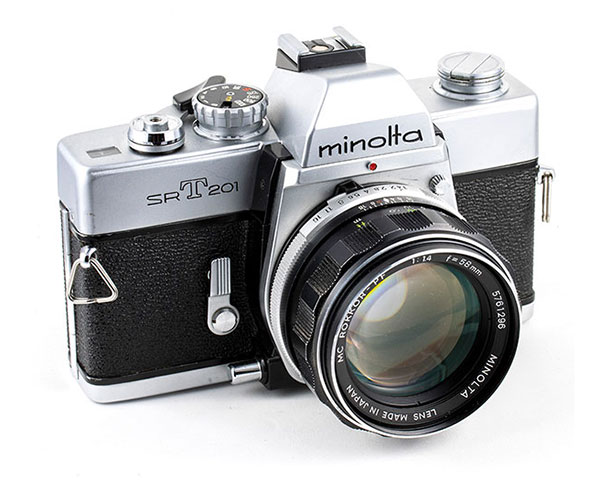
The SRT-201 replaced the original 101. In Europe the Pacific and Asia (except Japan), the 201 was named the 101b. In Japan it was the SR101. But whatever we call it, it lost the mirror lock-up. But by this time, of course, that feature was gone from all the models, anyway. But the 201 added a hot-shoe and a place on the camera back to place the film box top to remind you of the film you were using. As far as the viewfinder goes, just like the 101, only shutter speeds were visible in addition to the metering info.
Finally, the SRT-202 was released as the new top of the line SRT. In Europe it was named the 303b and in Asia it was the SR 505. And in addition to the lost mirror lock up, the 202 did gain a new feature in the form of a film safe-load indicator on the back below the winding lever. So, definitely a useful feature. And added the film memo space on the back.

This all brings us to 1977. And we really need to consider what Minolta was up to in 1977. It was this year that they released the XD series of electronically-controlled cameras. Notably, was the XD-7 (otherwise known as the XD-11 in the US). This was a multi-mode camera featuring shutter priority as well as aperture-priority auto-exposure. This was cutting-edge tech and was definitely going to be the future path for Minolta, BUT they didn’t abandon the SRT line. We did see a major change in the metering systems, though.
For the first time since the inception of the SRT 101 in 1966, we’d see the famous CLC metering system disappear from all of the models EXCEPT the premium 202. It was replaced by a simpler, one cell metering system. So, if you find a 200 or 201 without the CLC badge on the front of the prism, you’re looking at a post-1977 version. However, at the same time, the focusing screen was improved and added the split-image/microprism collar. This had previously been only on the upscale 102 and 202 models.
Also, those department store exclusives got new names: the MC became the MC 2, and the SC became the SC 2.
This now brings us to 1980. And we’re finally seeing the sun set on most of the SRT models. And by 1981, only the 201 and the 200 were left – and they wouldn’t live to see 1982. Because it was then that we got another famous Minolta – the X-700. But that is another story for another time.
I think these cameras – and especially the 102 – are just a joy to use. They’re not fancy – just straight-forward, no nonsense kind of cameras, with a really effective metering system. And pairing them with just about any manual-focus Minolta lens – from the early designs up through the MC and then the MD versions – is a recipe for success, in my opinion.
Minolta is a company I really miss having around. They built some great cameras and excellent lenses. And I always get a little nostalgic for Minolta this time of year. Because it was Christmas of 1986 when I got this X-700, my first real camera. So, I have Minolta to thank for fueling this lifelong fascination that I have with these things.
If you’re looking for a great, fully-mechanical SLR, I don’t think you can go wrong with a 101, 102, 201 or 202. But, my favorite of the lot is an early-model 102 that still has the mirror lock-up. And in addition to that, it has a full-information viewfinder, split-image focusing, and multi-exposure capability. You may not NEED multi-exposure or mirror lock up all the time, but it’s just nice to know you DO have it when you need it.
Be sure to check out the video version of this post below, along with a photo shoot and sample images.


Great article. Thank you for sorting this all out. I have always found the model numbering of this series to be confusing.
LikeLike