
A few posts back I was comparing three 100-speed films – two economy-priced films – Arista EDU 100 and Kentmere Pan 100 – against Kodak T-Max 100 – a decidedly non-budget film but one of my all-time favorites. The results were interesting and a bit eye-opening. Before the test I was absolutely certain that I hated the Arista film. After the test – not so much.
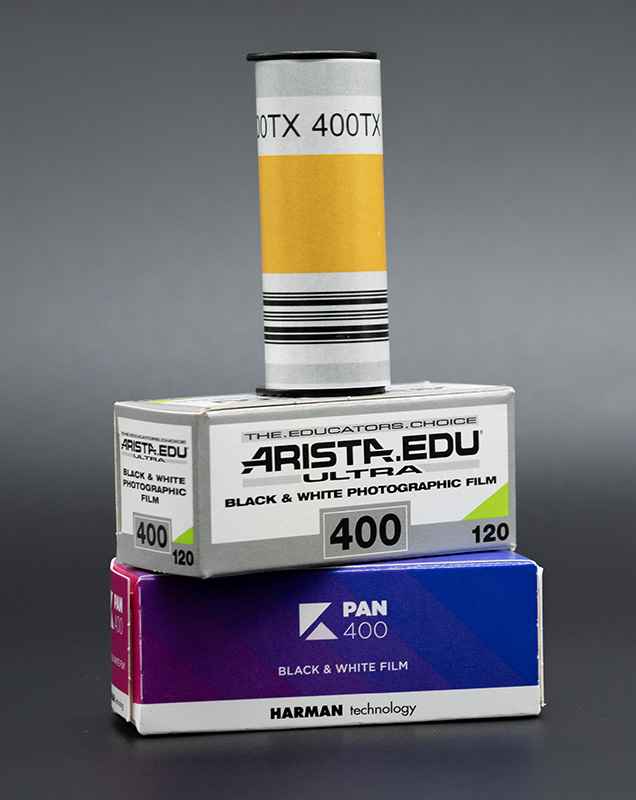
So, I’ve decided to do the same thing with the 400-speed versions. The main change for this test is that all three films use a traditional grain structure. While the previous test illustrated each film’s range of tones, it wasn’t overly helpful when comparing grain – since T-Max’s tabular grain is a lot less noticeable. And it really wasn’t fair to compare the other films to that. In hindsight, Ilford FP4 would’ve been a better choice than the T-Max. But for this test all films will have the same grain structure.
For my methodology, I’ll be using my Bronica S2A with three separate film backs. So each film will be getting the exact same exposure. And I’ll be using a tripod to keep the framing as close as possible for each.
For development, I’ll be processing each according to the manufacturer’s specs using D-76 in 1:1 dilution and intermittent agitation.
And as a final frame of reference, Kodak Tri-X is priced at about $9 USD per 120 roll, and the Arista and Kentmere are just under $6 USD per 120 roll. So the main question to answer here will be: is Kodak Tri-X worth paying 50% more for??
In the following video I get a bit more into the details than I did with the 100-speed test. And a lot of that will be looking at histograms and tone curves. But I think the results will speak for themselves.

 Vintage Camera Digest