
Riken Optical Industries began producing cameras as far back as 1939. And prior to that they were involved in various photographic endeavors back to around 1920. And over 100 years later, they’re still one of the major players in photography. During the past century they’ve produced a lot of different cameras in various formats – including 120 and 127, 35mm, 16mm, 110, and 126.
Their first twin lens reflex – or TLR – was the Ricohflex Model B in 1941. And as far I’m aware, there was no model A. This unusual naming convention was continued by Ricoh on some of their other cameras. For example, there were no Ricohflex models 1, 2 or 5 BUT there WERE models 3, 4, 6 and 7. So if you’ve been looking around for a Ricoh TLR and never see a Model A for sale – that’s why. I guess you could say that model is EXTREMELY RARE – as in so rare it doesn’t exist.
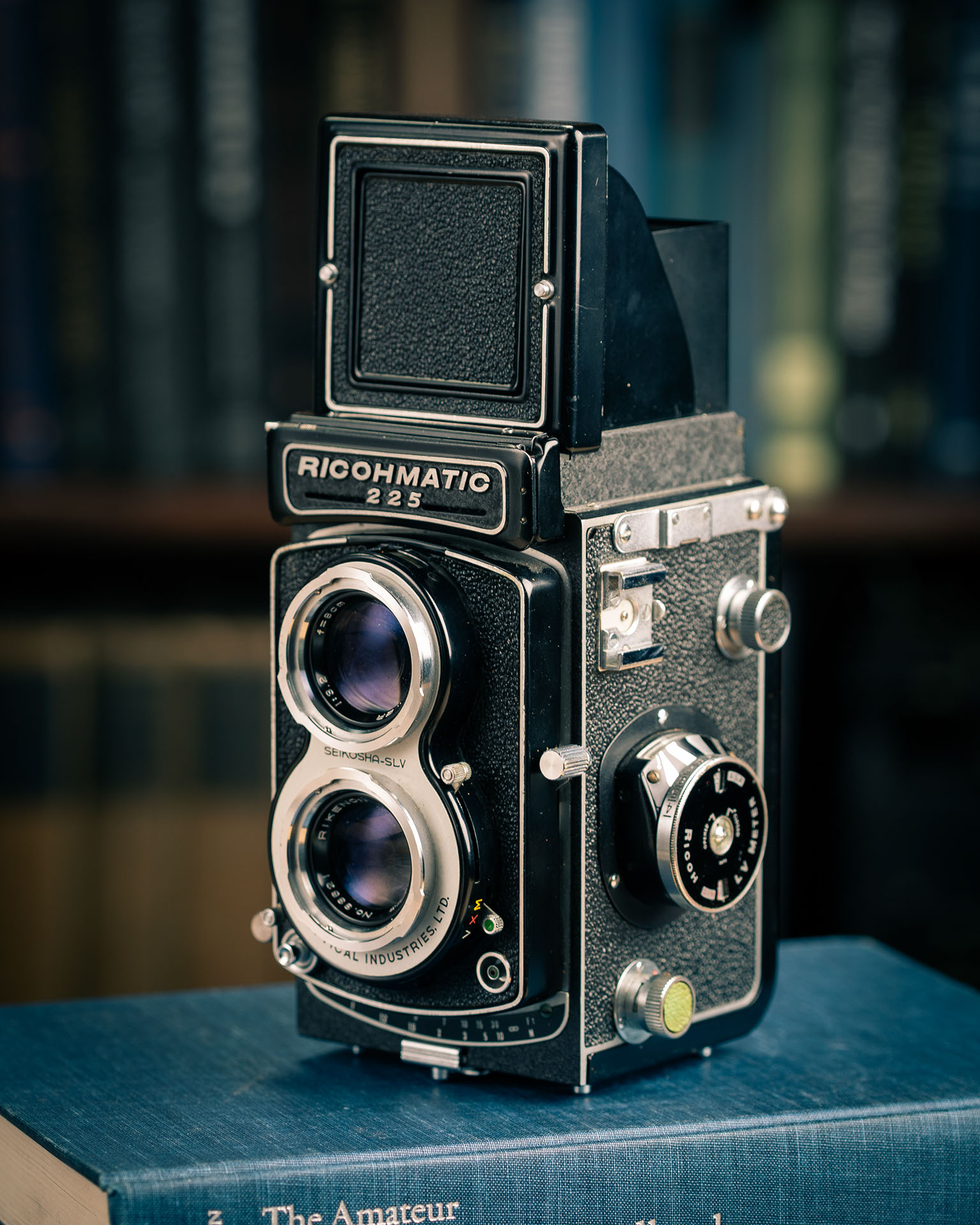
But, anyway, the camera I’m featuring today is the Ricohmatic 225 from 1959. And from what I can tell, it was the last 6×6 format TLR from Ricoh.
The camera uses 120-film for 12 exposures on a roll. Unlike later medium format cameras, though, it can’t use 220.
It has a built-in, un-coupled selenium meter. The one in mine still responds to light. And it uses the Light Value scale to determine exposure. I think the LV system makes a lot of sense, and is great at teaching the relationship between shutter speed and f/stop.
Check out the video below for more info and a photo shoot with the 225!


I’ve got an earlier Ricohflex Dia TLR and love it. I was looking for a good twin-lens reflex camera that would not break the bank like Rollei, Minolta, or even Yashica, and the Ricoh delivers.
LikeLike