
I began my photographic career in the Spring of 1989 as a darkroom technician at a local newspaper. And one of the perks of being the #2 photo guy in a department of two was the honor of being the main shooter on Saturdays. In a small town like ours was, there wasn’t (for better or for worse) much “hard” news going on during the weekends. The best we could usually hope for was an antique car show or the county fair to serve up some interesting feature opportunities.
If you know anything about county fairs or old car shows, you know they don’t happen every weekend. And that left me under a great deal of stress each Saturday to come up with something to be worthy of the front page of the Sunday edition. For somebody like me who enjoyed the relatively laid-back atmosphere of the darkroom, the pressure to find something worth shooting made me glad I didn’t do that all the time. So just think how out of place I’d have been in a busy newsroom in a major city! I was certainly aware of this – and even though I wouldn’t have wanted to be one myself – I developed an admiration for the big city photogs who lived their lives under such stress. And when you consider those stresses and pressures, equipment plays a big part.
This was back in 1989, and 35mm was the medium of choice back then for photojournalists – and had been so for at least a couple of decades. The 35mm systems (just like today’s digital) were small, lightweight, and had plenty of accessories, lenses, and flashes to round them out. But before 35mm took over the world of newspaper photography, the daily shooter earned his keep with medium and large format equipment. Medium format isn’t too unlike 35mm – just larger and heavier. And you don’t get as many shots per roll of film – usually twelve. But large format – well, that’s a different animal altogether.
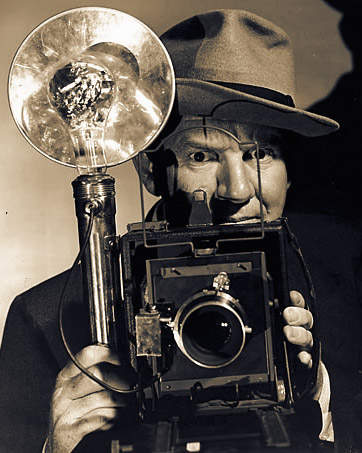
Shooting 4×5″ sheet film, the large format press camera was a newsman’s irreplaceable partner for decades. In fact, it wasn’t until 1954 that the Pulitzer Prize was awarded to a photograph that wasn’t taken with a Graflex Speed Graphic – a camera, that long with its sibling, the Crown Graphic, absolutely dominated press photography for the first part of the 20th Century. Think of the stereotypical, fedora-wearing, cigar-chomping, press photographer of the old days, and all bets are that he has a Speed Graphic in his clutches.

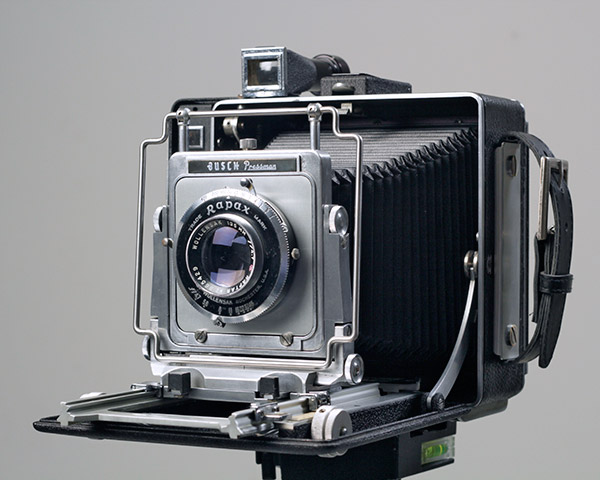
But in the early 1950s, the Busch Precision Camera Corporation of Chicago, IL decided to give Graflex some competition. Busch produced two models of press cameras: Model “C” – shooting 2 1/4 x 3 1/4; and Model “D” – shooting 4×5″. The Busch cameras set themselves apart from Graflex in several ways: they were smaller; they were made of metal instead of wood; and they featured a revolving back so that the film could be shot in vertical or horizontal orientation without having to hold the camera any differently. This last feature is important for larger cameras since their weight can make hand-held shooting difficult at best.

I picked up my Pressman at an antique shop about 10 years ago for around $50. I didn’t have a 4×5 camera in my collection at the time, so I was happy to find one at what seemed like a good price. I was more into “collecting” old cameras than “using” back then, so the camera sat on a shelf for a few years. But about three years ago I was scanning some old negatives at work when a portrait on 4×5 film crossed my desk. After scanning it I was completely blown away by the amount of detail and sharpness – a lot more than what my Canon 1D Mark IV was capable of. And like the “crack cocaine” of photography, I was hooked on large format from that moment on.

I immediately thought of the old Pressman sitting on the shelf, and wondered how much work it would take to get it back into working order. The bellows was still quite pliable and there weren’t any noticeable holes. I discovered the lens’ shutter was stuck, but I was undeterred as I quickly found a working replacement lens on Ebay. And after a month of complete tear down, cleaning, and re-assembly I was ready to shoot. And, man, was that an eye-opener. I quickly developed a new admiration for all of those photojournalists who shot Pulitzer-winning shots on these cameras. Large format photography is a pain! But it’s a pain that pays off.

Using the Pressman goes something like this:
- Set the camera on a tripod
- Open the lens to the maximum aperture and press the preview lever. The shutter opens to allow light to pass through to the ground glass.
- Frame up and focus the subject. The Pressman offers three different methods for this – the eyepiece viewfinder, the sports finder, and the ground glass. The first two of these are aided by the built-in rangefinder for focusing. But my rangefinder was missing the extension tube that you have to look through. Ground glass focusing is more accurate, anyway, but the existing pop-out viewing hood still didn’t give the best view of the upside-down and reversed image. I ended up removing the rear viewing hood (easy to do) and using a loupe to inspect the dim image. Focusing is done by rotating the knobs on the camera’s baseboard.
- Close the lens’ shutter by re-setting the preview lever on the lens.
- Determine exposure with a meter or sunny-16 rule and set shutter and aperture accordingly.
- Lift the back and insert the film/film holder.
- Cock the shutter.
- Remove the dark slide from the film holder.
- Trip the shutter. A cable release is helpful.
- Replace the dark slide in the film holder.
- Congratulations! You just made ONE photograph.
- Remove the film/film holder, turn it around, insert it and expose another sheet of film. Now you have TWO photos.
Now imagine doing this under pressure to shoot some sort of breaking news. I’d be a basket-case. Using the Busch Pressman for leisurely shooting, however, is a great exercise in photographic discipline.
The group of photos below the camera specs were all taken with the vintage-era Wollensak 135mm lens. For 4×5 film, this lens is just a little wider than “normal”. For even more mind-boggling sharpness, the camera can be fitted with more modern large format lenses such as the Schneider 150mm f/5.6. The standard lensboard will fit Copal #0 shutters, so other modern lenses may also fit. The only requirement for this besides the Copal #0 shutter size is that the lens’ rear element needs to be small enough to fit inside the front standard. So unfortunately, you won’t be able to get your Schneider 90mm Super-Angulon on there unless it’s the f/8 version.
All in all the Busch Pressman Model “D” is quite an able performer. The camera is built like a tank, and the craftsmanship is excellent. If you’re interested in large format but don’t have the cash to lay out for a modern field camera, the Pressman is a great (and I believe superior) alternative to the ubiquitous Graflex press cameras that you’re likely to find on Ebay and similar sites.
Technicals Specifications:
Original List Price (1952): $129.50 (w/135mm lens)
Price in 2015 Dollars: $1175.46
Manufacturer: Busch Precision Camera Corporation
Model: D
Year Introduced: 1952
Film Format: 4×5 Sheet
Lens: Wollensak Raptar 135mm f/4.7
Shutter: Rapax 1 sec – 1/400 sec, plus B and T
Shutter Release: on lens
F/Stops: f/4.7 – f/45
Built-in Meter: N/A
Flash Sync: Some lenses feature flash sync
Film Advance: N/A
Frame Counter: N/A
Double-exposure capable: Unfortunately, yes.
Finder: Ground glass, Eyepiece Finder, Sports Finder. Parallax correction.
Mirror: No
Other points of note: Revolving Back
Interesting note: when scanned at 32oo ppi, the 4×5″ negative creates an image file equivalent to 175 megapixels.


 Vintage Camera Digest
Great work. Very well taken photos.
LikeLike
Thank you, Ray!
LikeLike
Truly a wonderful camera, and your shots are fantastic – thanks for the article! BTW – You CAN mount and use your Schneider 90mm Super-Angulon as long as it is the f8 version (the rear element of the f5.6 version is too large). They can still be picked up reasonably, especially the earlier non-multicoated versions which should be fine for B&W work. Hope to see more of your work with this classic!
LikeLike
Thanks, Bates! It is a great camera. I love the size. And thanks for the info on the 90 f/8. It’s good to know that it will fit. The one I have is the f/5.6 version, though, so the rear element is too big for the front standard. I think I have heard that the Rodenstock 90mm’s will fit ok, too. Lately, I’ve been using the Schneider 150 f/5.6 on this camera. It works very well and the sharpness is exceptional.
LikeLike
Thanks for this article. I just picked one of these up and am enjoying learning about them.
LikeLike
That’s great, Brad! You’ll enjoy using the Pressman. Small and tough.
LikeLike
Hello, I just bought a Busch 4 x 5 that has a tan body and orange leather on the sides of the case! It is a thing of beauty. Does anyone know why they made this color combo?
LikeLike
The bellows are also tan.
LikeLike
Hi Michael – I have seen that color combination show up on eBay every so often, but it is rare. As for reasons why – I couldn’t say, other than it may have been considered one of those new “mod” color designs of the ’60s. Several other large format cameras had similar color schemes around that same time.
LikeLike
Hi Steven, thank you for the information! Drip by drip I am learning more about this lovey camera. This one is in amazing condition for its age. The rangefinder needs work but that is it!
LikeLike
I ended up removing the rangefinder and other external viewers and just use the ground glass. I was trying to make it fit in an old camera bag, and all that extra stuff was too much. Besides, I knew the rangefinder was out of whack and would take work. I’ll get back to that one day. Maybe. 🙂
LikeLike
That’s the version I have as well and, yes, it does seem to be somewhat rare. The case is painted a tan color, and the leather surrounding the case and the bellows leather are both an orange-ish “saddle tan” like color (not mod at all). I also located a matching tan Busch Pressman film holder to go with the kit. I have seen these versions referred to as a “safari” edition, which makes sense since I have seen at least one offered with what appeared to include what appeared to be a safari themed hard case covered in some sort of woven grass material. Mine, as several others I have seen, has a beautiful little gold finished plate on the back that reads “Made Especially For…(owner’s name)…by Busch Precision Camera Corp., Chicago, ILL”. This leads me to think that it was a limited special order item, but there is very little historical info out there re. Busch and their cameras.
LikeLike
Yes, this one came with the hard case you describe and the nameplate too. I think I’ll change my name to match the camera, I think it is really beautiful. Also small and solid! This one even has the instruction manual for the camera and the viewfinder.
LikeLike
You know, I have seen/heard about those with the personalized badges. I would guess a VERY limited run on that sort of thing. I’ve also read where manufacturers would do that to present to an employee for reaching a certain status within the company. At the very least you have a camera with provenance. A great find!
LikeLike
I love your review. I have my own Busch Pressman for 8 years already. I love it. I Have to say that I usually shoot in 8×10″ with a 1899 wooden camera, but there is something about using this 50’s beauty. I enjoyeed your pictures also. Great jow.
LikeLike
Thank you, Rodrigo! I really like the size compared to the more famous “press” 4x5s. That being said, I’m sure I’d be completely overwhelmed by an 8×10 from 1899! Gotta admire you for that!
LikeLike
Thanks for all the interesting and fun information.
LikeLike
You’re welcome, Judy! Glad you enjoyed!
LikeLike
You have quite a jewel there. I used to own one of the tan/tan Busch Model D’s, and it was my go to camera for portraits. I bought mine from a gentleman who decided to quit photography. Mine came with the 135 Raptar, a 8.5″ Commercial Ektar, and a 90mm Ektar, along with a dozen film holders, filters, shades, etc., all for the princely sum of $100. A few years back, I decided to get rid of all my film gear, and the Busch went to KEH along with my Mamiyas, a Super Graphic, and an Omega 4×5. Last year, all that changed, and I decided to get back into 4×5 photography. Since then, I’ve purchased a Cambo SC, and another Super Graphic.
A couple of months back, I was looking for a 150mm lens for the Super Graphic, and the man on eBay, described the lens, and some spare parts, all for $75. It turned out to be a complete Tower Press 4×5 with 10 film holders, and a Symmar 150mm f/5.6 convertible. The condition is excellent, with no light leaks, and everything except the wire frame.
I’ve picked up a couple of custom lens boards for it, and a Fujinon 90mm f/8. It’s a superb camera. The weather here in Michigan has been awfully cloudy. Just waiting to get some sunshine, and get mine out.
The images you’ve shown are excellent, and show a great deal of care in composition and exposure.
LikeLike
Thanks for your nice introduction to the camera, I just bought one on Ebay and now waiting for it to arrive.
Would you please tell us more about what lenses would fit? especially to utilize the movements this camera has?
And what lens did you use to get those astonishing images? like the portrait shots.
Great work and article.
Greetings from Frankfurt!
LikeLike
Oh, I just saw that all the images are taken with the “kit lens” Wollensak 135mm f4.7. That’s amazing.
I always thought to myself, how actually has the lens industry progressed… 🙂
LikeLike
Hi Zheng from Frankfurt! Good to hear from another Busch user. Congrats on picking up a fine camera. You will love it, I’m sure. Yes, all these images were taken with that old Wollensak glass. I did eventually pick up a nice Schneider 150mm 5.6 to replace it. The Schneider fits perfectly with the stock lens board and allows for good movements on the camera. The only negative I really find with the Busch is that the small design and narrow bellows do restrict what lenses will mount. Lenses with a large rear element will be trouble. For example my Schneider 90mm f/5.6 has such a large rear element that it won’t even fit through the front standard. The 90mm f/8 might fit through there, but the large size of the rear element will certainly restrict the camera movements, if only because the bellows is so small at the front. The old Schneider Angulon 90mm f/6.3 would probably be perfect for it, since it was used a lot on those press cameras. All this being said, I like the old Wollensak. But a 30-yr-old 150 f/5.6 Schneider or Rodenstock will give you slightly better sharpness. At least the Schneider does for me.
LikeLike
Hi all. I am buying one tomorrow with the 135mm Raptex and a top rangefinder. My question is how does the lens sync up to the rangefinder? Great pictures, beautiful tones.
LikeLike
Hi George – congrats on a purchase you will love. Most of these came with the 135 as standard equipment. So the lens stops on the bottom rail should be preset to the right spot. When you pull the lens/bellows out, you’ll pull it all the way to those metal tabs. There is also a distance scale connected to the bottom rail near the stops. It is easy to check the accuracy of the rangefinder against the image projected on the ground glass. When you achieve infinity focus on the gg the rangefinder should also reflect it. If it doesn’t match up, the rangefinder will need adjustment. If you’re lucky everything will be fine. If it’s out of calibration you can always use the ground glass. I know that’s a bit tedious, but it’s also likely to be the most accurate. Can’t wait to hear how it goes! Good luck!
LikeLike
Thanks for your reply. I’m an old pro with large format. I had a Linhof Super Technika 4 with with matching cams. More specifically if I use a 90 Raptex will the rangefinder couple with it? With Linhof I had to change cams Does the Pressman have a universal cam?
LikeLike
Ah…sorry for preaching to the choir 😁. As far as I know it only has one cam available. I’ve never seen any others.
LikeLike
I enjoy hand holding the camera and using the rangefinder for focus. I can also manage with the scale if the rangefinder is uncoupled I would like to avoid using the groundglass except for some situations. Thank you for your reply.
LikeLike
Understood! Best of fun with the camera. Keep us posted!
LikeLike
Bought a Pressman a few months ago to work on a lightweight minimalist approach to LF photography. Using a Fujinon 150mm lens, small backpack, Gossen Pilot2. What fun. The camera had no rangefinder but all else is in good shape. My project is to photograph one street in my town. Meet a lot of people with this camera. Thanks for the insight.
LikeLike
Hi Richard – I think the Busch is the perfect size for that. Sounds like a great project. I ended up taking the rangefinder off of mine. Keeps the size down and easier to pack. The Gossen is a good choice, I think. Wish they still made them like that. I shared one with my photo students last week. They were amazed at how it showed all the shutter/aperture combinations at once. Keep us posted on the project!
LikeLike
Just shot my first photographs with my “New to Me” Busch Pressman Model D. Always wanted to get into 4X5. In 1975, my uncle who was into estate sales picked up for me a Beseler 4X5 enlarger with all the accessories. Through the years, I used it for everything but large format. My darkroom fell into disuse until a couple of months ago when I volunteered to print 4X5 negatives that were archived in our small town’s museum. The negatives were from the local paper and dated back to pre-WW II through the early 60s. Most had never been published before. They were incredibly interesting and included everything from big movie stars that came to town for War Bond drives to terrible accidents. I know this phrase sounds overworked, but I was literally blown away by the detail on the prints. And these were made with old uncoated lenses. Your column convinced me to get a Busch Pressman and try my own 4X5 photos. Just so happened, I was able to trade a local used camera store for a fairly nice Pressman in return for some duplicate Zeiss Jena lenses that I had in my collection but are now becoming “cult lenses”. What a great camera. It is such a reasonable size and is hand holdable. Mine has a perfectly adjusted rangefinder. I am looking forward to going to our northern Michigan shoreline to shoot some snow covered dunes and also to use the rangefinder to shoot interesting people in our town. I actually think that shooting with the rangefinder is what excites the most. I haven’t smoked a cigar in decades but I think I might go out and buy a couple to chomp on while I am going around town photographing people – just like Wee Gee. Thanks for your column.
LikeLike
That’s truly exciting, Thomas! I’m definitely jealous of the 4×5 enlarger AND darkroom, for that matter, lol. Being “blown away” by the detail of a 4×5 neg is only cliché if you’ve never experienced it. Looks like you got hooked on LF by accident – just like me. But I imagine going through those old negs from the museum was a bonafide adventure. Back to the Busch – is your rangefinder on the side or one of the top-mounted “Vue-Focus” models? Glad it’s set up correctly in either case. And I doubt it would be too difficult to “tune up” if it ever needs it. I agree you can’t beat the size and portability of the “D”. And the revolving back is probably the biggest advantage over the Graflex competitors. ENJOY that fine camera! I think I’ll go pick up a cigar in your honor 🙂
LikeLike
Thanks for your kind response Steven. Great interaction with everyone. The rangefinder is a Kalart on the side. It is functioning well enough and the focusing spot is good, but would work a bit better if I could figure out how to take the rangefinder cover off and clean the interior glass up a bit. I did see a website devoted to press cameras and they have a copy of instructions from Kalart on how to adjust the rangefinder for other lenses, so there might be something there. This actually is the second rangefinder on the camera. The other one was somewhat larger and left impressions in the leather when it was removed. So it is most probably a newer rangefinder, which may be why it works. I was surprised that the rangefinder did worked because the store said it was disconnected. However, it is just a matter of making sure that the lens board is between the infinity and about the 3 feet area on the focusing rack. If you pass 3 feet, the rangefinder looks like it freezes up but it is just over extended. Also, the arm from the rangefinder to the focusing rack was sticking from lack of use. A little back and forth freed it up. Finally, this rangefinder has an interesting attachment, which I don’t have, but the socket for it is there. A light bulb attaches to the top of it and directed down. It reportedly will send two light beams from each of the front rangefinder windows for focusing in the dark. When the beams come together the camera is in focus. Now that is cool.
LikeLike
Ah, so your Kalart utilizes the “Focuspot” – or at least set up to accept that accessory. I’ve read about them but have never seen one in action. The concept seems solid, though, and I’m sure proved useful for after dark photojournalism. I’ve not considered how difficult that might be with a press camera. Heck it’s hard enough with modern equipment. Feel free to share some of your shots when you get a chance. Sounds like you found a great example of a great camera. Happy shooting!
LikeLike
hI Steven, do you have a sync socket for flashes on the raptar? thanks! Eric
LikeLike
Hi Eric – the first lens I had for the camera did have the double-prong bi-post flash connection. I wonder if they still make adapter cords for those?
LikeLike
Hi Steven, yes you can find some adapters, but it is expensive: https://paramountcords.com/product/bp-pf-bipost-to-pc-female-6-inches/
But it is also possible to do something by yourself with two wires and a Pc sync socket!
https://lommen9.home.xs4all.nl/GRAFLITE/index.html
LikeLike
This is great to know! Thanks for this!
LikeLike
Nice review. I have a Bush Pressman too, and it’s a great camera. Doesn’t quite the movements of something like a Linhof, but doesn’t cost nearly as much either 😉
I like the shot of the fence on the dunes – really shows off the large-format look. Did you think about using the front rise for some of the architecturaral shots?
LikeLike
Hi Alasdair – thanks for the comment. I did think about front rise on some of those shots, but the coverage of that original lens proved to be pretty marginal. I got pretty extreme vignetting. Replacing it with a Schneider 150mm made a big difference in getting more use out of the camera’s movements. I do think the Busch is a great camera overall – especially when paired with a modern-ish lens. Built to last!
LikeLike
I hear you – the Raptar isn’t a bad lens, especially as it normally comes free with the camera, and it’s nice and compact, but you soon reach the edges. The Schnieder is great though – I have a 180, and it’s sharp with great coverage..
LikeLike