

The first Bronica camera (Bronica Z) appeared in 1958. The founder of the company, Zenzaburo Yoshino, had set out a decade earlier to create the perfect camera. And when the “Z” came out, it was quite unique in its features: a 6×6 120 film shooter with focal-plane shutter that maxed out at 1/1250, and an instant-return reflex mirror that slid down and forward under the lens instead of flipping up. This mirror action resulted in a very short viewfinder “blackout” time. With most reflex cameras of the era, the mirror remained in the “up” position, blocking the viewfinder until the film was wound on and the shutter cocked.
The early Bronica 6×6 designs – in my opinion – are some of the most beautiful cameras ever produced. Sporting stainless steel chrome and two-tone gray leatherette, it’s obvious that Yoshino considered camera looks as important as function. And while all-black models were available, nothing is more striking to me than those chrome and gray models.
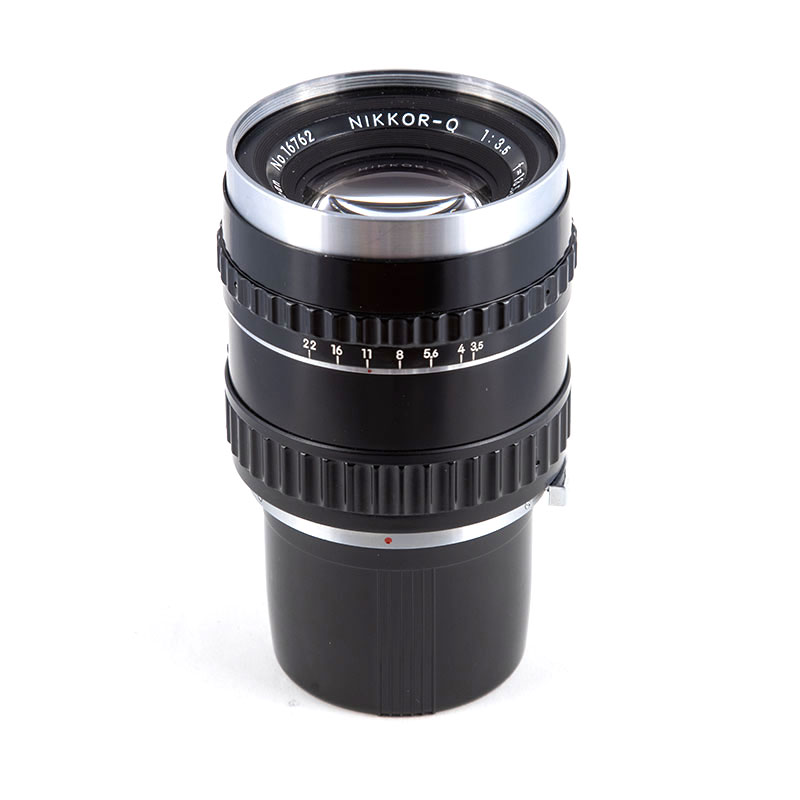
Also notable in the design was the focusing helicoid built into the camera instead of the lenses. Available lenses were basically just the element blocks that attached to the camera helicoid. Most of the company’s resources had been used up in the development of the camera body and Yoshino had to look elsewhere for lenses. And he was able to strike a deal with Nippon Kogaku (Nikon) to produce these. If you’ve ever wondered what a Nikon medium-format lens would be capable of, pick up one of these older bodies with the Nikkor-P 75mm 2.8 and you won’t be disappointed.
The “Z” was followed up by the “Deluxe” – and it was replaced by the Bronica S in 1961. The “S” was a bit more basic with shutter speeds only to 1/1000, but mechanically improved. The “S” was followed up by the C, which was quickly followed up with the C2 and the S2. The differences between the C2 and S2 were that the C2 didn’t offer interchangeable film backs, and only had a fastest marked shutter speed of 1/500. However, the shutter dial of the C2 included a blank area past the 1/500 mark that when set to that was, indeed, 1/1000.
Also on the C2 and S2 for the first time was a removable helicoid which made it possible to use much longer lenses that would included their own. One of the drawbacks of the camera-mounted helicoid was that it had a set range of movement, resulting in limitations of close-focusing for short telephotos such as the 135mm and 150mm.
Bronica stuck with this basic camera design with the S2A, EC and EC-TL models into the mid-70s, when they were replaced by the lens-shutter ETR 6×4.5 system. The cameras that followed – SQ, SQ-A, SQ-AM and GS-1 – would all be based on leaf-shutter lenses. Bronica would go on to produce cameras through 2005. The last of which was the RF645 rangefinder.
You’ll find a video review on the S2a below. And here’s one on the lenses for these early models.
Bronica cameras in my collection


Video Review
Bronica Lenses




All text and photographs on this website (other than found-photography and otherwise noted) are © 2014-2021 Steven Broome. All rights reserved.
 Vintage Camera Digest