
In the last post I talked a little bit about US camera manufacturing in the last episode when we were discussing the Kodak Signet camera series. And it was sort of implied – although I think it could be outright stated – that when it came to camera design, the US had wildly different ideas and goals than manufacturers in Germany or Japan. The latter two set the precedent for fine, tightly-engineered, mechanical masterpieces. The US on the other hand seemed to be happy enough as long as the camera worked – and more importantly – sold. By the end of the 19th Century, Kodak had taken photography – a craft that was highly technical and quite expensive – and successfully brought it to the masses. And other American companies were paying attention.
One such company was the International Radio Corporation of Ann Arbor, Michigan. They were manufacturers of radios – no surprise there – but they were using a relatively new material called Bakelite in their construction.
Bakelite is a plastic material that can easily be formed into complex shapes. As opposed to metal which requires more expensive machining and stamping, or even wood – which might be hard to source on demand. The use of this plastic meant the construction material could be produced in-house. And it could be easily shaped into whatever component you needed. AND done so at a much-reduced cost which could be passed on to the consumer. So these plastic, Bakelite radios were great sellers.
But, back then radios were a seasonal item. They sold well in fall and winter when folks spent more time indoors but not so well in spring and summer when more time was spent outdoors. So the president of International Radio Corporation, Charles Verschoor, came up with the idea to produce cameras made of Bakelite that would take advantage of the public’s growing interest in Kodak’s new 135 cassette film.
So, in 1936 they released the Argus A at a price of $12.50 USD – which was unheard of at the time for a camera that used this new, much smaller film. By the way, that prices equates to about $290 USD today. But sales of that camera were good – very good. So good in fact that the company sold off its radio patents and decided to go into camera production full-time, changing its name to International Research Corporation and were soon adding new cameras to their lineup.
In 1938, they released a new camera design, the Argus C, that included an un-coupled rangefinder. Un-coupled just means that you use the rangefinder to find the subject distance, then manually transfer that distance to the lens. But the next year, 1939, they released the C2 – which featured a coupled rangefinder. The rangefinder being coupled means that as you use the rangefinder to find the subject distance, it’s also connected to the lens focusing unit. So you don’t have to manually set the lens distance anymore. And this led to more precise focusing.
Later that same year, they made a minor update to the C2 by adding flash-sync contacts and changed the name of the camera to the C3. And the rest is history. This camera became the best selling, US made, 35mm camera ever. It was in production in one form or another from 1939 – 1966, and during that time over 2 million of them were sold. And that’s why you can go into just about any antique shop in the US and find one…or five.
There are also a couple of special variants of the C-3. There was the Colormatic and the two-tone Matchmatic. The color-matic just used some color-coded exposure controls. The match-magic used a simplified exposure system that supposedly was easier to understand than shutter speeds and f/stops. And it required a matching accessory light meter for that system to work. I think it turned out that it wasn’t so simple after all. But the C-3 IS the ubiquitous vintage camera in the US.
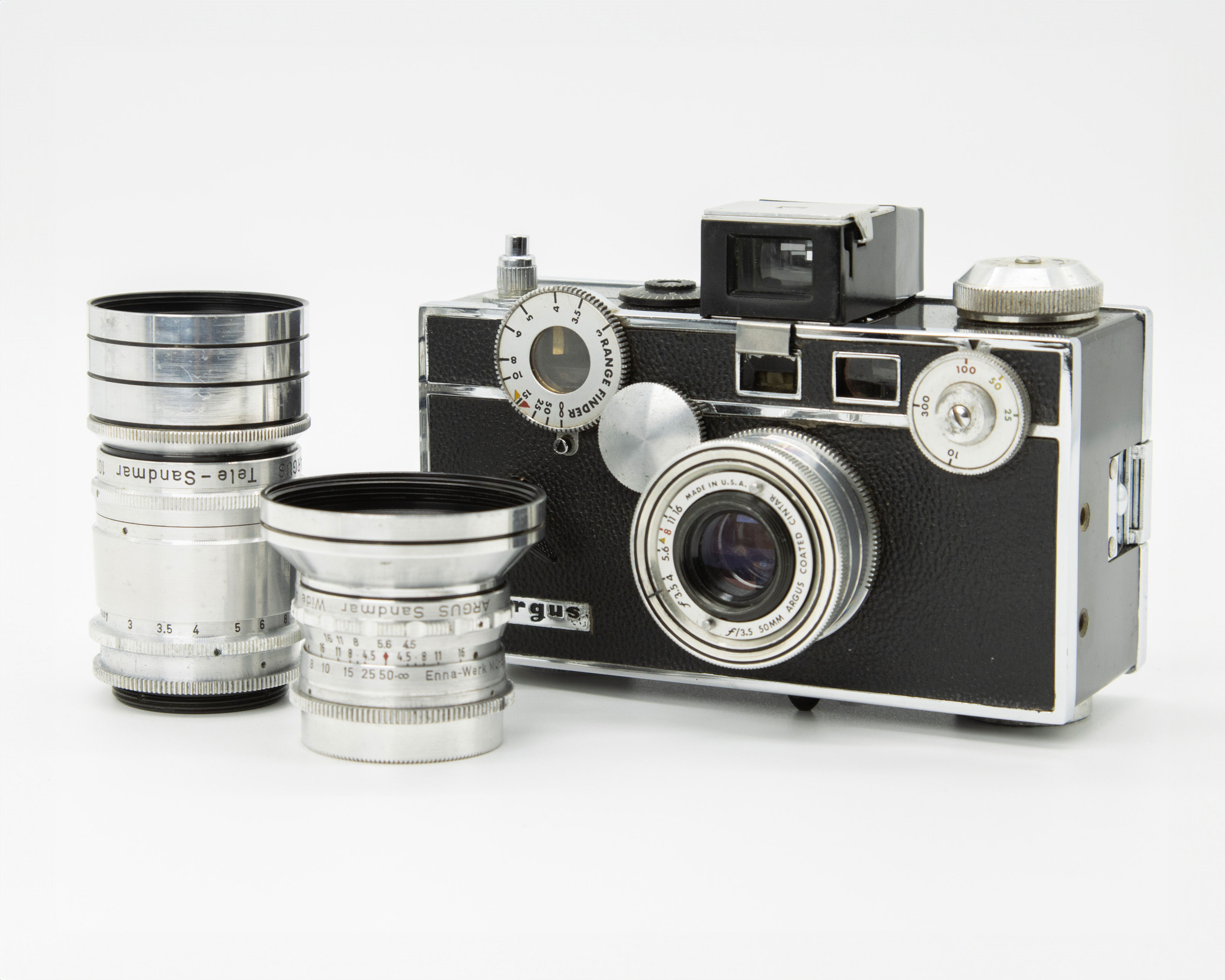
A C-3 was one of the first cameras I bought for my collection in the early 1990s. It looked old, and it looked cool, but I didn’t know a single thing about it. It was plagued with hazy viewers and dried out grease, but I didn’t really have any intention to use it. I just wanted to sit it on my office shelf to be a conversation piece. But 35 years later, here I am with a reason to shoot it. So, I’ve tuned it up and cleaned it and now it’s ready for some film.
And one thing I discovered in that process – and this may be well-known to some of you – but these cameras are designed to accept interchangeable lenses. In addition to the standard 50mm f/3.5, there is a 35mm 4.5 and 100mm 4.5 available for the C-3.
The standard lens for the C3 is a made-in-the-USA 50mm f/3.5 Cintar that’s a coated anastigmat. It’s a 3-element design – based on the Leitz Elmar – with a 9-bladed diaphragm to keep that bokeh circular throughout the 3.5 – f/16 range.
The two additional lenses were NOT made in the US. Both of these were manufactured in Germany by Enna-Verk. We have a 35mm 4.5 Sandmar wide-angle. And a 100mm 4.5 Tele-Sandmar. Both are coated anastigmat designs just like the standard 50 AND have 9-bladed diaphragms as well.
And since this is a rangefinder and not an SLR, we have to make use of an accessory viewer when using these lenses. The viewer clips on top and around the rangefinder window in the back, so that it’s located directly above the lens. And it has a drop-down mask that restricts the angle of view to match the 100mm. Without the mask, the viewer matches the angle of view of the 35mm. This is a very simple viewer, though, and has no way to compensate for parallax.
The method for changing these lenses, though, is not for the faint of heart. And I would really hesitate to try to do it out in the field. It involves un-coupling the rangefinder from the lens by completely removing the idler gear that connects it to the lens (so don’t drop it!), unscrewing the mounted lens, screwing the new lens on, aligning infinity focus marks, and re-installing the idler gear.
Luckily, these cameras are cheap. So I picked up two more and just went ahead and mounted the accessory lenses on those. And how did they work out? Check out full video below to hear the rest of the story.

 Vintage Camera Digest