
I don’t think anyone would be surprised if I were to assert that historically, the United States has never been that competitive when it comes to the manufacture of fine cameras. And I’d say the top US contribution to photography has mainly been with film – and that has mainly been from Kodak, of course.
Now this isn’t to say that the US didn’t manufacture its share of cameras. Because obviously Kodak did produce cameras – a LOT of cameras during the span of the 20th century. As a matter of fact, according to one of my favorite camera books, McKeown’s Price Guide, there are well over 800 distinct film camera models that have been produced by Kodak. But the overwhelming majority of these cameras were marketed to the “casual” user. And this was an excellent business model – because somebody’s got to make cameras for the common people so that they can buy some film, right? Absolutely nothing wrong with that at all.
And it’s kinda like US companies knew their place in the camera manufacturing world, anyway. And they very seldom produced anything on a level to compete with what Germany or Japan was doing. And as a matter of fact, the Kodak cameras that many would consider their best – the Retina series – were made in Germany. And if you compare those cameras to what they were producing in the US – well, the differences in fit and design are certainly obvious.
Now even though we can recognize this distinction – between Kodak cameras produced in the US and Kodak cameras produced abroad – it doesn’t mean that Kodak US never tried to do any better. Because there are definitely some that prove this out. Probably the most famous of which is the Kodak Ektra of 1941. If there was ever a Kodak camera absolutely intended to be top of the line, this was it. A 35mm rangefinder with interchangeable lenses that also sported interchangeable film magazines. And it went for the astronomical price of $325 USD. In 1941. In today’s money that’s equivalent to about $7000 USD. So it’s no wonder you don’t see many of these for sale today. But if you do find one for sale, be prepared for sticker shock.
But if you’re looking for a US-made Kodak that’s relatively high-spec’d yet still reasonable in price, you’ll find several in the Signet series of 35mm cameras. So let’s take a look.
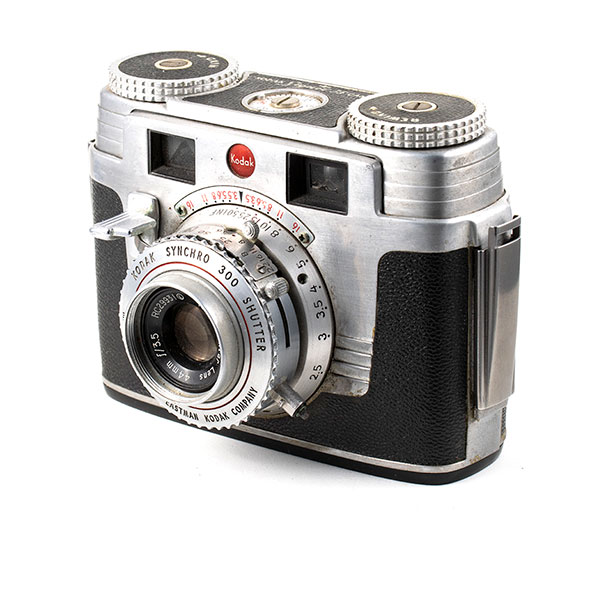
The first camera in this series is the Signet 35. It was produced from 1951-1958. It’s a cast aluminum rangefinder design with an exceptional 44mm f/3.5 Ektar lens and has a Kodak Synchro 300 shutter. But it only has 4 timed shutter speeds: 1/25 to 1/300 of a second PLUS B. It’s price upon release in 1951 was $95 USD – about $1200 USD in today’s money.
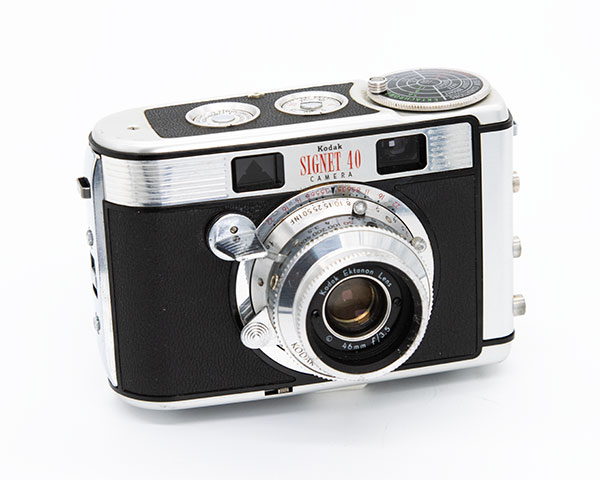
The second camera in the series is the Signet 40. Produced from 1956-1959, it’s also a rangefinder design, but is built mostly of Bakelite with a few metal panels. It features a 46mm f/3.5 Ektanar (not Ektar) lens in a Kodak Synchro 400 shutter. The speed range is ⅕ to 1/400 second plus B. Its price upon release in 1956 was $65 USD – about $775 USD in today’s money. And the 40 definitely has the best shutter speed range of the entire lot.
The third camera in the series is the Signet 30. It was produced from 1957-1959 and has a 44mm f/2.8 Ektanar lens in a Kodak Synchro 250 shutter. Shutter speeds are ¼ to 1/250 second plus B. And the camera is mostly Bakelite construction. The 30 looks like a rangefinder, but it’s only a viewfinder camera. And when it was released in 1957, it was priced at $55 USD – equivalent to about $635 USD today.
The Signet 50 was also released in 1957 along with the 30. It’s practically the same camera as the 30 with an added selenium exposure meter. So it’s also not a rangefinder camera. The original price for the 50 was $83 USD – equivalent to about $950 USD today. And that seems like a LOT of money for this camera – I’m not gonna lie.
And finally we have the Signet 80 that was released in 1958. It basically took over the top spot in the lineup when the original Signet 35 ceased production. It’s a rangefinder design mostly made of plastic with a few metal panels and features a 50mm f/2.8 Ektanar lens. It has a leaf shutter behind the lens with speeds from ¼ to 1/250 second, plus B. It does include a selenium exposure meter AND…drumroll here…the ability to change lenses.
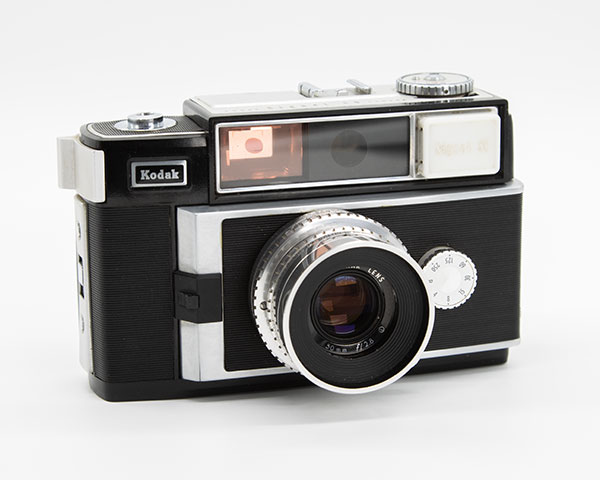
In addition to the standard 50mm lens, there is also a 35mm and a 90mm – as well as an accessory viewfinder for use with the additional lenses. The price of the Signet 80 with the standard lens in 1958 was $129.50 USD – which is about $1450 USD today.
Some things to note about the 80. It’s significantly larger than any of the other cameras in the series. But the viewfinder is huge and bright with an amber color. That contrasts with the blue, circular rangefinder patch to make focusing super easy. Not only is the 80’s viewfinder the best in the Signet series, but in my opinion, it’s one of the best you’ll find on any rangefinder.
There are also a couple of “oddities” on the 80. First, when loading film, there is no take-up spool – just a slot to insert the film leader. Kodak calls this “injection” winding. Also, the winding mechanism itself is unique. Pushing this lever forward two strokes will wind the film to the next frame.
The 80 also has a built-in selenium meter, and just like most other cameras from this era, it’s based on the Exposure Value system. However, the shutter and aperture rings are not locked together. So you can move them independently. Just note that the f/stop markings are on the bottom of the lens.
And while we’re talking about the lenses, it’s interesting to note that the 50mm and the 90mm lenses available for the 80 contain Thoriated elements. Which means they’re somewhat radioactive.
Now when you look at all of these as a series – and why wouldn’t you, since they’re all Signet cameras – you might get the impression that there wasn’t a unified marketing strategy at play. You have the first camera – called the 35 – all metal body and excellent lens, but a mediocre shutter, then the second camera – the 40 – totally different design, mostly plastic, a faster shutter, but a lesser lens.
Then you have two viewfinder models – the 30 and the 50, with even more plastic in the build, a slower top shutter speed, but using a faster 2.8 lens. And the 50 includes a meter.
Then there’s the 80 – completely different design than any of the others, still uses the slower shutter, but it’s a rangefinder AND it uses interchangeable lenses.
In the South, we might say that the Signet series is sorta like a pot-luck dinner party. No real cohesive relationship among the features and specs of these, other than the 30 and 50 sharing most of their design elements. But maybe I’m just being nit-picky about it. What matters is – are they fun to use?
Check out the video below for more info and a photo shoot with the Signet 35 and Signet 80.

 Vintage Camera Digest
Although they are not on my camera’s range, with out doubt these cameras streamline design, the Kodak commitment to creat so many models and, all the details you presented us, has lots of interest.
One of my favourite cameras, concerning beautiful organic results and a pleasure to carry and shoot with, is my beautiful Retina IIIC, and the three lenses system.
Best regards
LikeLiked by 1 person
Yes, any of the Retina series are examples of fine cameras. Excellent workmanship and engineering. Kodak was fortunate to acquire the Nagel company and continue that work.
LikeLike
Very interesting! I must admit I knew nothing about any of the Kodak Signet cameras untilo i read your post! They look an interesting bunch. Maybe not many made it to Great Britain when they were new? Anyway they are new to me and I like the look of them. Great post, I like reading about ‘new’ cameras that I have not come across before.
LikeLike
I would be surprised if many made it over your way. The 35 model is operationally quite simple and non-impressive. But the lens really shines. The other models seem as kitschy as any mid-century design. The model 80 had some promise but wasn’t executed well. Maybe you’ll find a 35 over there. Keep an eye out!
LikeLiked by 1 person