
Over-hyped? Or a solid choice?
If you’ve been in the market for a vintage film camera over the last several years, you’ve undoubtedly stumbled across a lot of these. Whether it’s the original AE-1 or the follow-up – the AE-1 Program, there’s no shortage of these out there. And if you’ve done any research on whether or not it might be a good choice to start your film-photography journey, you’ve also probably seen a lot of ridicule directed toward it – mostly along the lines of “it’s over-hyped, there are lots of better cameras out there”. And I’ll also echo that last part: there are indeed lots of better cameras for you to choose from.
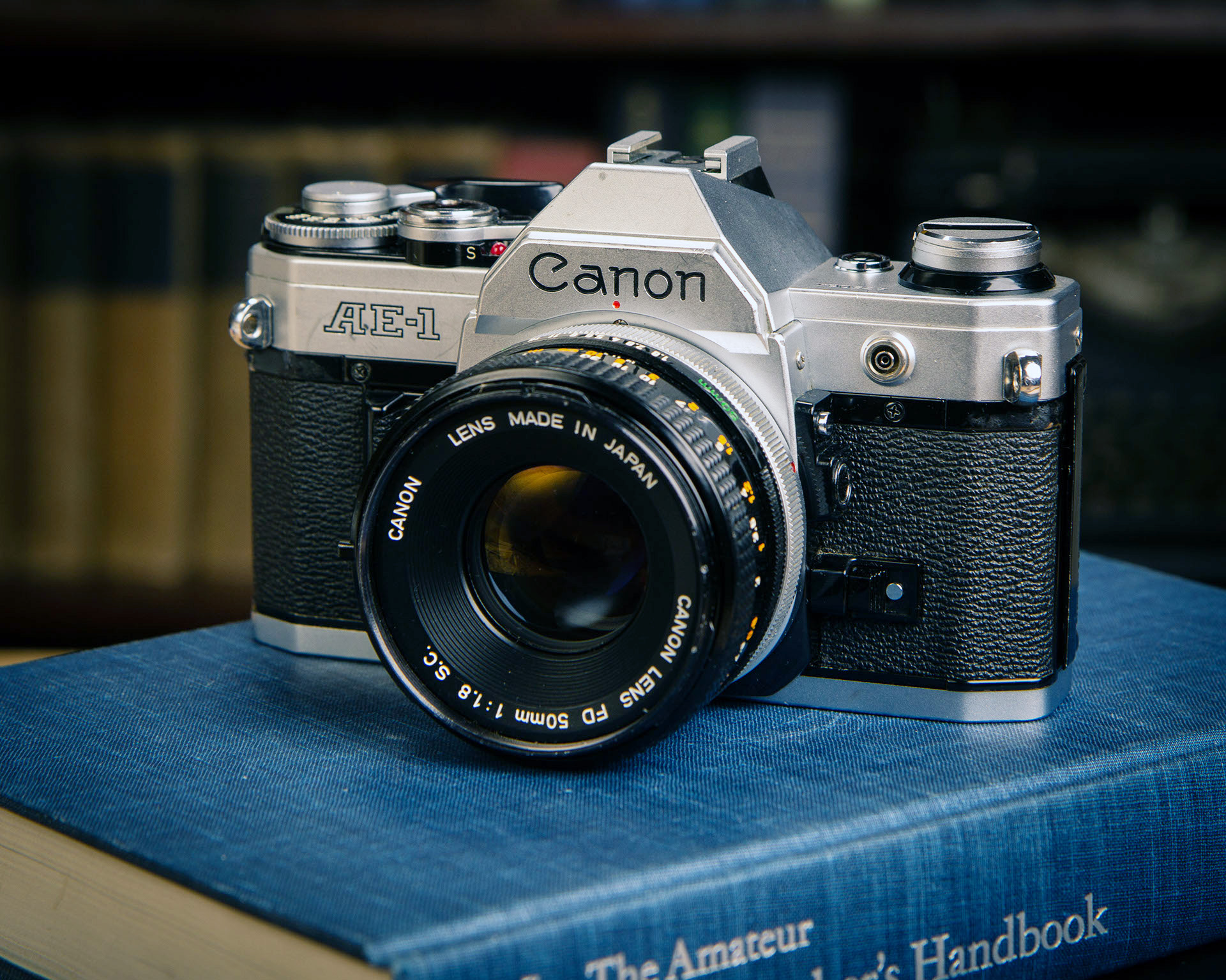
But that doesn’t mean this is a “bad” camera. It’s actually a pretty good camera. Its features are completely in line with most other cameras that were available in the mid-to-late 70s. Plus it offered auto-exposure – which was usually reserved for more expensive cameras of the time. And it offered this at a very reasonable price.
I’m gonna admit that, yes, there is a great deal of hype surrounding the AE-1 series. But I also want to point out that there was a tremendous amount of hype surrounding these cameras when they first appeared on the scene. That was the point. And the fact that there are so many of these cameras still out there to this day, points to the success of a rather genius marketing strategy.
The camera wasn’t particularly revolutionary when it came to features. Autoexposure wasn’t a new thing anymore. Plus, Canon already had that in their earlier EF model. And neither was it revolutionary when it came to price.
I dug through the back pages of this Popular Photography issue from March 1977 just to see what the street prices were.
The AE-1 with an f/1.8 lens went for $265 USD. That’s equivalent to about $1400 in 2025 money. And that’s about where we’d expect a mid-range camera to run today. But there WERE some that had lower prices:
The Yashica FX-1 was listed at $230. The Konica Autoreflex TC and Miranda EE2 were both listed at $195. The Ricoh TLS EE was listed at $160. And the Konica AutoReflex T-3 was listed at $265 – the same as the AE-1.
Cameras that were more expensive at the time were the Fujica ST901 at $290, the Minolta XE – at $309, the Nikkormat EL at $330, and the Olympus OM-2, which was the highest at $390 (which would be equivalent to about $2100 today.
And all of these prices included the 50mm 1.8 – or similar – lens.
But if we look at where the AE-1 stood in relation to Canon’s other cameras, it was their cheapest model at the time. Although it wouldn’t hold this position for long because within the same year, Canon would release the AT-1 – a totally manual camera with the same basic design as the AE-1.
But the things that Canon had that set it apart from those other manufacturers – who offered less expensive autoexposure cameras – was reputation and marketing power. And that helped them create one of the most successful ad campaigns that the camera sector had ever seen.
Even as a 9-yr-old kid, I knew about the Canon AE-1 because of all the television commercials. And if you look up any of these old ads, you’ll see one thing they all seem to have in common – action photography. It’s all about the ability of this camera to freeze action. And that makes perfect sense. Because one of the many drawbacks of shooting with an Instamatic or a simple point and shoot is that you have very little control over motion. And that meant snapshooters ended up with a LOT of blurry photos.
Most of the other autoexposure cameras on the market then which competed with the AE-1 (with the exception of Konica) featured aperture-priority exposure. And that, of course, controls depth of field – which might be a more difficult concept for snapshooters to grasp. You know, I don’t know how many of my family’s vacation shots were ruined because of depth of field problems. But I absolutely knew we had a fair share of shots ruined by motion blur. And if the AE-1 can help fix that, I’m in.
Now besides the clever marketing, there were a few other things that the AE-1 had going for it. It relied on more electronics than most of its contemporaries. And this led to fewer overall parts and an easier manufacturing process. It also used more plastic than other cameras at the time. This made it lighter. And this is probably one of the things that turned some people off. But we know now that plastic would eventually become the standard for most camera manufacturing. If Canon didn’t do it with the AE-1, someone else would’ve done it. All manufacturing was moving in that direction anyway.
Another thing Canon did with the AE-1 was to make it smaller. Not as tiny as the Olympus or Pentax cameras, but definitely smaller than Canon’s own FTb or EF.
So what we end up with is a smaller, lighter, easy to understand SLR that’s gonna help us take fewer blurry photos. AND at a reasonable price.
But…the story doesn’t end there.
Two years after the AE-1, Canon released a new flagship camera for their A-series – the A-1. Definitely upscale and marketed toward the advanced-amateur/prosumer crowd, it was the first of any camera to feature Programmed auto-exposure – which is where aperture AND shutter speed are set automatically. This really does let you just “press the button”. And even though Canon put this on a more advanced camera, it also made perfect sense to put it on a camera that snapshooters would find appealing. So in 1981, five years after the AE-1, they released the AE-1 Program.
The AE-1 Program offered a somewhat updated design and included the new Program mode in addition to shutter-priority. And it sold VERY well. Chances are you, or a family member, or a neighbor, or a friend’s family had one of these. I was lucky enough that my elementary school librarian, Miss Cobb, had one she was willing to let us borrow. And I got a first taste of what a “real” camera was. And just look at what it’s led me to!
Check out the video below for the full review and sample photos.

 Vintage Camera Digest