
The 1980s were a very fruitful decade in the evolution of 35mm SLRs. We got built-in winders, more metering options, faster shutters, and most importantly – auto focus. Sensibilities and expectations had changed. And new technologies were helping re-shape our understanding of what cameras could actually do – and how our photography could be better for it. And we absolutely cannot discuss the development of the Nikon F4 without setting the broader stage of what was going on with autofocus during this time.
Now, for reference, keep in mind that the Nikon F3 was released in 1980. But, in 1981, Pentax released the ME-F. It was really the first attempt at an autofocus SLR. Aimed at the amateur market, It had one lens available that contained the focusing motor, and it wasn’t fast or particularly accurate.
In 1983, Olympus released the OM-F (or the OM30 in some markets). Also aimed at the amateur market – only one lens was released for it. And like the Pentax ME-F it featured the focusing motor in the lens. Also like the Pentax ME-F, its performance was lackluster.
In 1983 though, Nikon released the F3AF. Definitely NOT aimed at the amateur market. It was an F3 with a special, huge prism. It was considerably more expensive than a regular F3, but they did release two special lenses for it. And each lens contained its own focusing motor. But it seems that pro users weren’t sold on autofocus – and at that time it probably DID seem a bit gimmicky. And I’d surmise that pros were certainly capable of focusing faster and more accurately with their F3 and manual-focus lenses.
In 1985, Canon jumped into the mix with their autofocus T80. Definitely aimed at the amateur market, it offered auto-exposure only, but it did release three special lenses to accompany it. And again, the autofocus motors were located in the lenses.
So you see we have a pattern here. With the exception of the Nikon F3AF – manufacturers were targeting the amateur market with the new autofocus technology.
But – in 1985, Minolta dropped the Maxxum 7000 bombshell on the world, and the camera landscape was forever changed. Saying it was successful would be an understatement. And Minolta’s approach was unique among all the other manufacturers up to this point. For starters, they developed a brand new lens mount AND released an entire range of lenses for it right from the beginning – not just 2 or 3 like the others had done.
Secondly, where everyone else was intent on putting the autofocus motors in the lenses. Minolta designed their camera to use an in-the-body motor. And thirdly, they made the 7000 a camera that offered rather advanced features – like multiple exposure modes. So it wasn’t just something aimed at beginners. All of this resulted in an autofocus camera system that advanced users could appreciate AND was accurate and relatively fast – two things that seemed to be missing from the other offerings.
What Minolta managed to prove was that auto-focus could be an important selling point for the beginner to advanced-amateur market. But what about the pro market?? Would pros finally warm up to autofocus technology?
Well, Minolta decided to test that too. Because the same year the 7000 came out, they also released the 9000 – which was specifically aimed at the pro market. It was supported by all the same great lenses that the 7000 used, you could interchange film backs, AND add a motor drive that would fire 6 frames per second. And in 1985, that was pretty doggone fast. But did the pros take to it as Minolta hoped? Would the 9000 go down in history as THE camera the pros wanted? Not really.
But selling professionals on the 9000 was gonna be an uphill battle anyway. The Minolta AF system was based on an entirely new lensmount. So there was no compatibility between it and the manual focus Minolta lenses. So if you were a working pro, the first thing you’ll have to do is spring for a new arsenal of glass. And I doubt that was something pros were willing to do for a brand new system. So, the Minolta 9000 wasn’t causing pro users to abandon Nikon (or Canon) for a variety of reasons. BUT, the way Minolta approached integrating autofocus into their lineup made all the others take notice AND rethink their approaches.
What the success of the Minolta 7000 proved to all the other camera makers, was that, yes, autofocus was definitely the next big thing. And if you weren’t already spending enough time and money addressing this on your own camera systems, you were gonna get left behind.
So in 1986, Nikon came out with their own answer to the Minolta 7000 – known as the N2020 in the states and the F-501 to the rest of the world. And this time, instead of putting the focusing motor in the lens, they opted for putting it in the body – just like the mega-successful Minolta. But Nikon had a slightly different reason for this.
Unlike Minolta – who developed an entirely new lens mount that required different lenses – Nikon chose to KEEP the same lens mount. And this is important in Nikon’s overall story. Because the thread that runs through all of it – all the way back to the first Nikon F in 1959 – is non-obsolescence.
I mentioned this in the last post talking about the F3. But never was there a better illustration of this than on their decision to build their autofocus cameras based on the same old F-mount. Think of it like this: picture yourself a pro Nikon user in the mid 1980s. And over the years you’ve spent a small fortune gathering up the best of the Nikon lenses. But now, there’s this new thing called autofocus that’s pretty certain to eventually become a standard. Will your collection of great glass just become expensive paperweights??
Well, Nikon was determined to not let that come to pass. So, when the N2020 (or F-501) hit the market, the new AF lenses that accompanied it used the tried and true F-mount – only adding a small connecting pin to drive focus in the lenses. So you could own the new autofocus body and use all of your existing manual focus lenses with it.
A second point to make where the Minolta and Nikon trajectory diverged was that the Minolta 7000 featured LCD panels and buttons to supplant the dials and levers on their manual focus bodies. But the N2020 was designed to be almost indiscernible from earlier cameras. There was no real learning curve to be – learned. And this was no accident.
The next year, 1987, saw Nikon release another AF camera – the N4004 (or F-401). It was marketed as an entry-level body, and while not using LCD screens and buttons to operate, it did evolve a bit – as the shutter speeds, as WELL as the f/stops, could be controlled by a top-mounted dial. Very similar to what Canon had done with their A-1 almost a decade earlier.
Now, I’ve talked a lot about autofocus so far. And I will say THAT was the driving force in camera development at that time. But, there were a few more things Nikon had been working on since the release of the F3 all the way back in 1980.
If you read the last post about the F3 you may recall that the one area it could be considered “deficient” was regarding flash: no hot shoe and a non-impressive flash sync speed of 1/80 sec max. And this was something Nikon planned to overcome. They also believed that a faster shutter overall – based on a vertically-traveling design – was possible. And in 1982 they proved that out with the release of the FM2. It featured a mechanical shutter that could achieve speeds of 1/4000 sec, plus offer a 1/200 sec flash sync speed.
In 1983, they released an update to the FM2, and two additional models, the FE2 and the FA. With the FM2n, the mechanical shutter was upgraded so that a flash sync of 1/250 sec was possible. The two other new cameras had electronically-controlled shutters that could reach speeds of 1/4000 sec and also sync with flash at 1/250 sec. The FE2 offered an extended range of shutter speeds – all the way down to 8 secs as well as aperture-priority auto-exposure. But the FA was something else.
Not only did the FA have the same fast shutter as the FE2, it also featured multi mode auto-exposure with aperture-priority, shutter-priority, program AND manual exposure modes. But what really set the FA apart from every other camera on the market at the time was its metering – as this was the first use of multi-segment – or matrix metering – dividing the frame up into 5 different sections, analyzing the light data in each section, and comparing that analysis to an internal database of lighting situations to provide a nearly foolproof exposure. But this new metering – as well as the fast, electronically-controlled shutter – hadn’t really been proven out in use, yet. And Nikon being Nikon wasn’t about to put some unproven tech in an F-series camera. But that fast shutter, the fast flash sync, the matrix metering, and autofocus were the four major upgrades that Nickon would be implementing in their next flagship.
And in the fall of 1988, all of this new tech, plus a brand new autofocus system finally came together…in the F-801 – or N8008 as it was known in the US. It bore little resemblance to any Nikon camera that came before. Because in addition to the implementation of the faster shutter, matrix metering, and autofocus, it featured a body devoid of manual dials and cranks. Instead, this camera got LCD screens and button-controlled menus. And even though it was an overall great camera that some pro users actually added to their bag, it still fell short of what Nikon expected for a pro F-series model.
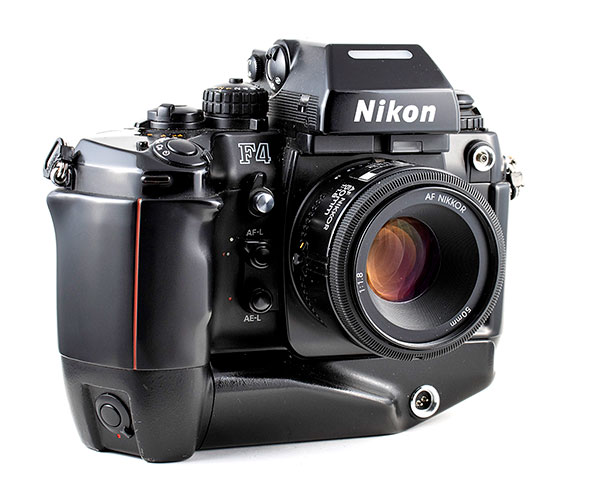
Now, I can imagine that at this time Nikon users were really beginning to wonder when they might actually see an F4 and what would that even look like. Well, in December of 1988 we finally found out. And it was unlike anything we probably imagined. For a completely electronic camera, it was notably devoid of LCD panels and menu buttons. Instead, its controls were at once familiar – and weather-sealed with o-rings and gaskets – we have an actual shutter speed dial, a manual rewind crank, and levers for controlling the exposure modes, metering patterns, and motor drive options. The latter being capable of reaching speeds of almost 6 frames per second. And this was now built-in. Well, at least in the US.
Upon its release, there were two different versions of the camera. In the US, the camera came configured as the F4S – which came with the MB-21 high-speed motor drive. In other markets though, you could also get just a plain F4. It used the smaller MB-20 grip and had a maximum frame rate of 4 frames per second. Still not too shabby.
But with the F4, we finally had a camera that made use of all the technological advances that Nikon had been testing on its various cameras throughout the 1980s. We had a super-fast shutter with a high-speed flash sync of 1/250 sec, we had matrix metering (as well as a couple of other choices) and we had autofocus. But saying it like that makes it sound like those were the only cool features. And that’s anything but the truth. The engineering and design of this thing is just incredible. And it would feel just as at home in the hands of a manual-focus pro as it would any techie upstart in the late 1980s – like me. I don’t think there’s ever been a camera that married tried and true mechanical-like design with cutting edge tech like this one did. It was meant to appeal to Nikon’s loyal professional base without forcing them into the world of new camera tech.
Check out the video for the rest of the review and sample photos.

 Vintage Camera Digest